Certifications, Compliance & the Documents to Ask For
Most compliance problems in a fabricated metal order are not caused by a missing certificate. They are caused by nobody writing down which requirement applies, who is responsible for meeting it, and what evidence has to be supplied with the shipment.
Two kinds of requirement, two different owners
Most compliance problems in a fabricated metal order are not caused by a missing certificate. They are caused by nobody writing down which requirement applies, who is responsible for meeting it, and what evidence has to ship with the goods.
The first table below separates the two categories, and the rest of the page lists what a manufacturer can genuinely provide, which standards are commonly referenced and what to ask a supplier before you commit.
The one distinction that prevents most compliance problems
On a fabricated metal order there are always two different kinds of requirement in play, and they belong to different parties.
| Requirement type | What it covers | Who owns it |
|---|---|---|
| Process and supply requirements | Whether the correct material was used, whether it was made to the drawing and the specified finish, and whether the records exist | The manufacturer — this is what a factory quality system and inspection records evidence |
| Product and market requirements | Whether the finished product may be sold in a market: electrical safety, EMC, machinery, medical device, pressure equipment and similar | You, as the party placing the finished product on that market |
A factory making a metal enclosure cannot certify the equipment that goes inside it. An enclosure maker that claims to hold the electrical safety approval for your product is either confused about the scope or describing something it does not control. Getting this distinction clear at enquiry stage saves an expensive conversation later.
What a manufacturer is genuinely able to provide
- Material certificates for the sheet, tube and hardware used, tracing the batch back to the mill or supplier.
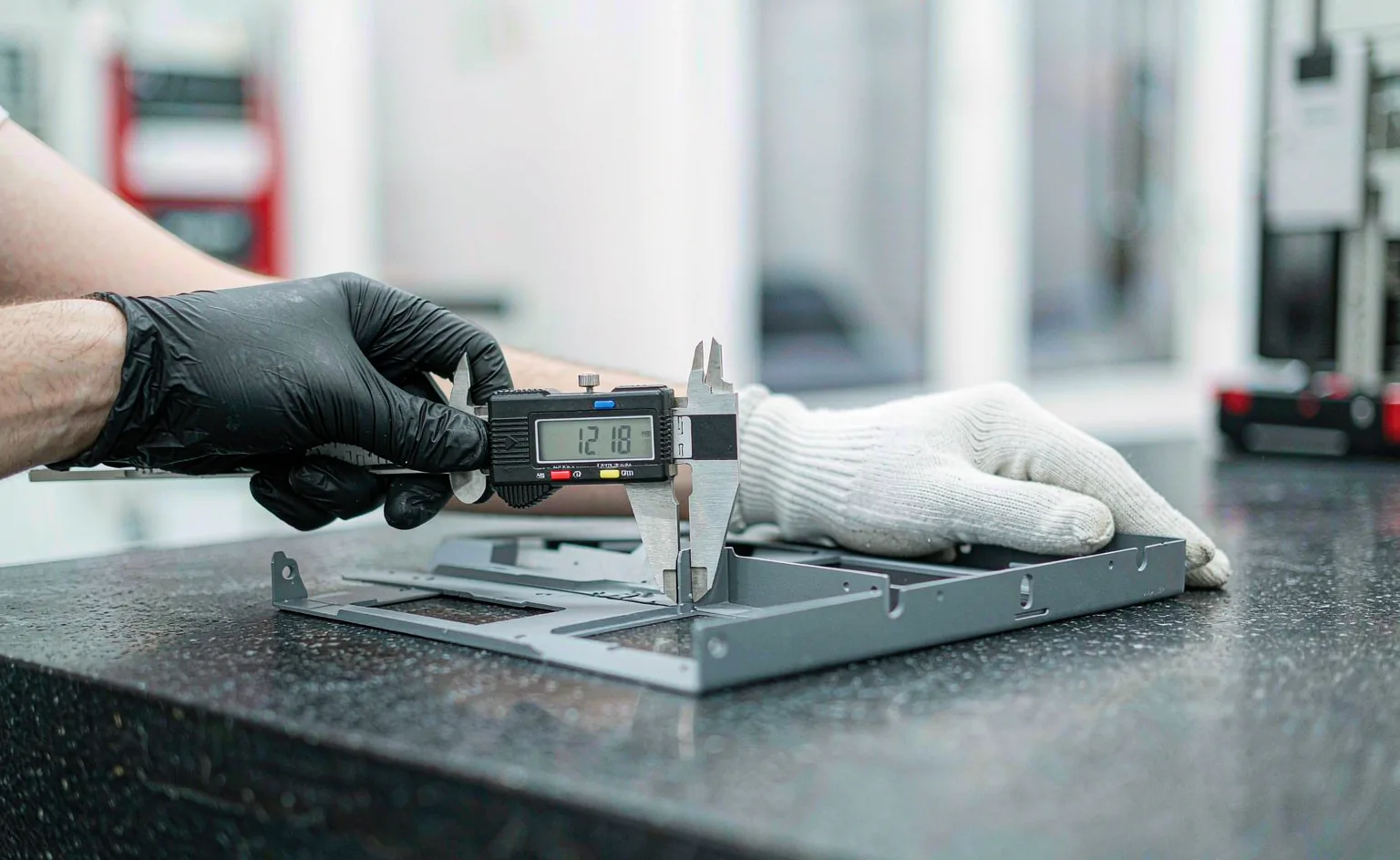
- Dimensional inspection records with measured values against the drawing revision.
- Process records for finishing: coating specification, film thickness, pre-treatment and cure control.
- First-article and sample approval records that can be referenced to a specific approved part.
- Conformity or inspection statements covering the scope actually supplied, rather than the whole assembly.
- Test reports from third-party laboratories where a coating, plating or weld test is specified, arranged on request.
On quality management, we operate our production and inspection processes in line with an ISO 9001 quality management system, and supporting documentation can be provided on request for your assessment. Details of individual certificates are shared directly with customers during supplier qualification rather than published on this site.
Standards commonly encountered on enclosures and fabricated parts
The table below is a starting point for the conversation rather than a compliance claim. Whether any particular standard applies to your order depends on the product, the market and your own obligations.
| Area | Standards and requirements commonly referenced | Typical relevance |
|---|---|---|
| Quality management | ISO 9001 | Applies to the manufacturing organisation and its processes |
| Sheet metal tolerance | DIN 6935, ISO 2768, GB/T 15055 | Defines general and bend tolerances on the drawing |
| Welding | ISO 3834, EN ISO 9606-1 for welder qualification | Required where welded joints are safety-relevant or specified |
| Electrical enclosure protection | IEC 60529 (IP), UL 50 / NEMA 250 (Type ratings) | Protection of the housing against dust, water and access |
| Electrical equipment | IEC 61439 for assemblies, IEC 62368-1, UL 508A | Applies to the completed electrical assembly, not the empty shell |
| EMC | EN 55011, EN 61000 series, FCC Part 15 | Applies to equipment that emits or is affected by interference, so it is a product-level requirement |
| Corrosion and coating | ISO 9227 salt spray, ISO 12944 for protective paint systems | Used to specify and verify coating performance |
| Materials and RoHS | RoHS directive for coatings, plating and hardware | Restricted substances in the materials supplied |
| Export control | Material and end-use rules on the destination market | Relevant to high-grade alloys and certain end uses |
| Machinery | EN ISO 12100 for machinery safety principles | Applies to guarding and access, as a product-level requirement |
How to specify compliance so there is no argument later
- State the requirement on the drawing, not only in an email. General tolerance, coating specification and any required test belong on the revision being manufactured.
- Agree the document set at order stage. Saying that a material certificate is needed after the sheet has been cut means the batch record has to be reconstructed.
- Identify the interfaces that carry a functional or safety requirement, so tolerance effort is spent where it matters.
- Decide who tests what. If salt spray, weld or electrical testing is needed, agree who arranges it and who pays for it before production.
- Keep one revision. A requirement added verbally to a running batch is the single most common cause of a compliance dispute.
Questions worth asking any supplier
- Which specific document will accompany this shipment, and in what form?
- Which material grades were used, and can the batch be traced back to the source?
- What is measured on each batch, at what frequency, and what happens when a reading is out of tolerance?
- Which party arranges third-party testing where a test is specified, and what does it cost?
- What is out of scope for the supplier's conformity statement?
- How are deviations from the drawing recorded, and who approves them?
Verifying a supplier without visiting
- Ask for documents that can be checked against the goods — the material grade and batch on the certificate should match the material on the parts.
- Ask what is measured, not whether ISO is held. A supplier that can describe its inspection points is telling you more than one that quotes a certificate number.
- Request a live video walkthrough of the specific line, machine or inspection area that will run your part.
- Order a first article and inspect it yourself before committing to a production quantity.
- Use a third-party inspection where the order value justifies it, and agree the inspection criteria in advance so the result is a pass or fail against a written standard.
Common Questions
No. Markings that assert conformity of a finished product — electrical safety marks, machinery marks or similar — may only be applied by the party that holds the corresponding approval and takes responsibility for the finished product. Markings that identify the part, the material, the batch or the drawing revision are applied as part of the order.
Yes, where the requirements fall inside our scope. Agreements that place product-level obligations such as finished-equipment safety approval on us are not something we can accept, because they fall outside what a fabricated-metal supplier can control.
Yes. Inspections by SGS, BV, TUV or your nominated representative can be arranged and attended, with the inspection criteria agreed beforehand so the outcome is measured against a written requirement rather than an opinion.
Any deviation is proposed to you in writing and applied only after your approval. The approved revision is recorded against the work order, so the parts and the records always refer to the same drawing.
Send Us Your Drawing
Tell us what you need made, the environment it works in and the quantity — we will return engineering feedback and a quotation, typically within 24 hours on working days.