Thermal Design for Solar Inverter Enclosures: Heat, Airflow and Shading
Solar Anjue Metal | Energy | 10 min read | Updated Oct 13, 2026
An inverter converts power, and conversion produces heat. That heat has to leave the enclosure, and the way it leaves is decided by the enclosure design: how much surface there is, where the air can move, what the vents let through besides air, and where the sun lands. Thermal design is one of the few enclosure problems that cannot be fixed later with a bigger fan, because the space for that fan is decided by the layout.
- The Thermal Problem in One Paragraph
- Start With the Heat Load, Not the Fan
- The Three Routes Heat Leaves
- Passive Cooling: Getting the Most From the Case
- Forced Air and Closed-Loop Exchange
- Louvres, Filters and the Protection Trade-Off
- Shading, Orientation and Where the Sun Lands
- Internal Layout and Airflow Inside the Cabinet
- What to Check on the Build
- How We Approach Inverter Enclosure Thermal Work
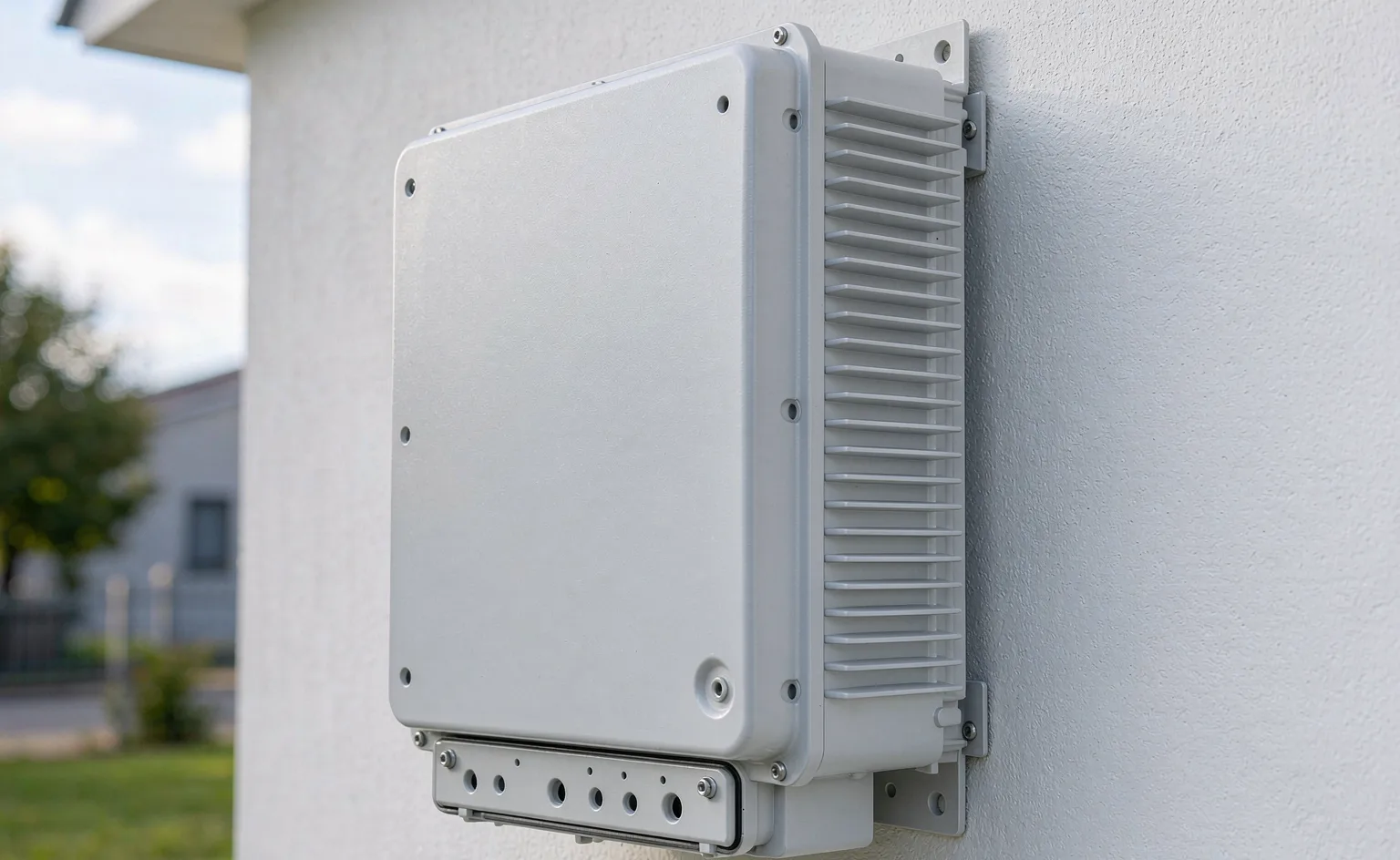
The Thermal Problem in One Paragraph
Heat gets into an inverter enclosure from two places: the losses inside the inverter and the sun on the outside. It leaves by three routes: conduction through the case and its mounting, convection and radiation from the surfaces, and any deliberate air path through the enclosure. Almost every thermal decision is really a decision about how much of each route is available, and every one of them is set by the geometry, the material and the openings.
Start With the Heat Load, Not the Fan
- Get the loss figure in watts from the inverter datasheet, at the operating point that matters.
- Add the solar gain on the enclosure, especially on a dark, sun-exposed face.
- Add any other heat inside, such as a filter fan or a transformer.
- Decide the ambient and the allowable internal temperature before choosing a cooling method.
- Keep the margin visible: a design that works only on the coolest day of the year does not work.
The Three Routes Heat Leaves
| Route | Depends on | Fails when |
|---|---|---|
| Conduction to case | Material, wall thickness, contact area | Case is thermally isolated from the interior |
| Convection to air | Surface area, exposure, air movement | Cabinet is boxed in or in still air |
| Radiation | Surface finish and temperature | Dark, enclosed or obstructed placement |
| Forced air | Air path, fan, filter, opening size | Filter clogs or vents are too small |
| Closed-loop exchange | Exchanger capacity and layout | Undersized for the worst ambient |
Passive Cooling: Getting the Most From the Case
- Use the case as a heatsink where the inverter mounts metal-to-metal, and keep that contact clean and flat.
- Increase effective surface area with ribs, fins or a larger enclosure rather than with thicker walls.
- Keep the cabinet off a warm wall, with an air gap, so both faces can convect.
- Choose a light finish where solar gain matters, and a matte finish where glare does not.
- Accept that passive cooling is limited by surface area and ambient, and size accordingly.
Forced Air and Closed-Loop Exchange
- Size fans and filters for the heat load at the worst ambient, not the average.
- Provide replaceable filters and document the change interval, because this is the maintenance item that is forgotten first.
- Use closed-loop exchange where dust, salt or humidity make filtered outside air a bad idea.
- Keep the air path logical: cool air in low, warm air out high, with nothing blocking either.
- Provide fan failure detection or at least a visible indicator, because a stopped fan is an invisible fault.
- Leave room for a larger fan than the first design needs, if the layout allows.
Louvres, Filters and the Protection Trade-Off
- Remember that a louvre that keeps rain out also restricts airflow; the two cannot both be maximised.
- Provide labyrinth or baffled louvres where driving rain is a risk.
- Keep the IP rating honest: a louvre is an opening, and the enclosure's rating is what the finished assembly achieves, not what the sheet metal achieves on its own.
- Mount filters so they can be changed without tools where the site is accessible, and behind a lock where it is not.
- Do not let a warm exhaust discharge into an intake, on the same cabinet or the next one.
Shading, Orientation and Where the Sun Lands
- Treat the sun-facing face as the hottest face and design around it.
- Use a shade structure, a hood or a double skin where direct sun is unavoidable.
- Prefer an orientation that puts the largest surface out of the afternoon sun where the site allows.
- Keep vegetation and equipment from blocking the intended airflow path.
- Remember that a reflecting surface next to the cabinet, such as a white wall or a metal roof, can add to the load.
Internal Layout and Airflow Inside the Cabinet
- Put the hottest component where the coolest air arrives, usually low and at the inlet.
- Keep clear space above and below components rather than stacking them tightly.
- Avoid a short circuit airflow that enters and leaves without crossing the heat source.
- Separate the power section from the control section where temperatures differ, so a hot area does not cook the electronics.
- Provide a mounting plate or rails that let components be moved if the thermal result needs adjusting.
What to Check on the Build
| Check | Method | Why it matters |
|---|---|---|
| Vent and louvre free area | Measure against the design | Airflow capacity |
| Filter fit and access | Fit and removal test | Maintainability |
| Case contact face | Straight edge and visual | Conduction path |
| Fan mounting and wiring | Fit and function test | Reliability |
| Air path obstruction | Visual | Avoid short circuit |
| Labels and warnings | Visual | Service safety |
| Surface finish | Visual | Solar gain and corrosion |
How We Approach Inverter Enclosure Thermal Work
- We fabricate housings, mounting plates, louvre panels, vent frames, hoods and double skins in steel, aluminium and stainless.
- We hold the vent and louvre openings to the sizes you specify and confirm the free area rather than the sheet area.
- We will tell you when a protection class and a ventilation requirement cannot both be met in the geometry you have drawn.
- We do not supply inverters, fans, filters or thermal controllers, and we do not certify the thermal performance of the finished assembly.
- Every quotation states which operations are completed in our plant.
Send the heat load, the ambient conditions, the protection class and the mounting arrangement, and the enclosure can be built with a real thermal path rather than a hopeful one.
Frequently Asked Questions
It depends on the surface area, the temperature difference between the inside and the ambient air, the material and the mounting. A larger, well-exposed metal enclosure radiating and convecting into free air can remove a useful amount of heat with no moving parts at all, which is why wall-mounted inverters often rely on the case as the heatsink. The moment the enclosure is small, is mounted against a warm wall, is in still air or is in the sun, the passive capacity drops and the calculation has to be done properly. We ask for the heat load and the ambient conditions rather than assuming a figure.
It depends on the environment and the heat load. A vented enclosure cools better but admits dust and moisture, so it needs a filter and a filter maintenance plan. A sealed enclosure keeps contamination out but must be cooled another way, often through the case or with a closed-loop exchanger. In a clean, shaded, temperate site a filtered vent can be the right answer; in a dusty or coastal site it usually is not. The protection class and the cooling method are one decision, not two.
Yes. A dark enclosure in full sun absorbs more solar energy than a light one, and that energy ends up inside. Where the thermal design is tight, a light, reflective finish and a shaded or well-ventilated mounting reduce the load. Colour is usually decided by the brand long before anyone does the thermal calculation, which is exactly why the enclosure should be sized with solar gain included rather than added afterward.
A fan moves filtered outside air through the enclosure, which removes heat efficiently but brings in whatever is in the air. A closed-loop heat exchanger or an air-to-air unit moves heat out without letting outside air in, which suits dusty, corrosive or humid sites at the cost of a lower cooling capacity for the same size. The choice follows the environment first and the heat load second.
No, and a fabricator who says otherwise is overreaching. The thermal performance of the finished assembly depends on the inverter's own losses, the mounting, the site conditions and the airflow around the cabinet, none of which are fully ours. What we can do is build the enclosure you specify, with the surface area, airflow openings, vent provisions and material needed to meet the thermal brief, and tell you when the brief and the protection class conflict.
Explore Related Capabilities
- Solar Inverter Enclosures — Inverter housings for rooftop and string systems
- Aluminium Enclosures — Lightweight housings with good heat transfer
Have a Drawing to Quote?
Send STEP, DXF or PDF drawings and we reply with engineering feedback and a detailed quotation within 24 hours on working days.