Control Panel Enclosure Fabrication: PLC Cabinets and Automation Enclosures
Control Panels Anjue Metal | Industrial | 12 min read | Updated Oct 12, 2026
A control panel enclosure is judged on the day it is commissioned, not on the day it is delivered. If the mounting plate is in the wrong place, the cable entries do not line up with the ducts, or the door does not compress its gasket, those problems surface in the plant rather than in the workshop. This guide covers the fabrication decisions that decide whether commissioning is straightforward.
- What a Control Panel Enclosure Has to Do
- Formats: Wall-Mount, Floor-Standing and Modular
- Frame Construction and Dimensional Discipline
- Mounting Plates, DIN Rails and Internal Layout
- Gland Plates, Cable Entries and Busbar Openings
- Doors, Latching and Protection
- Thermal Provisions Built into the Enclosure
- Protection Class and Where It Is Lost
- Finish, Labels and Documentation
- First-Article Checks
- Our Approach to Control Panel Enclosures
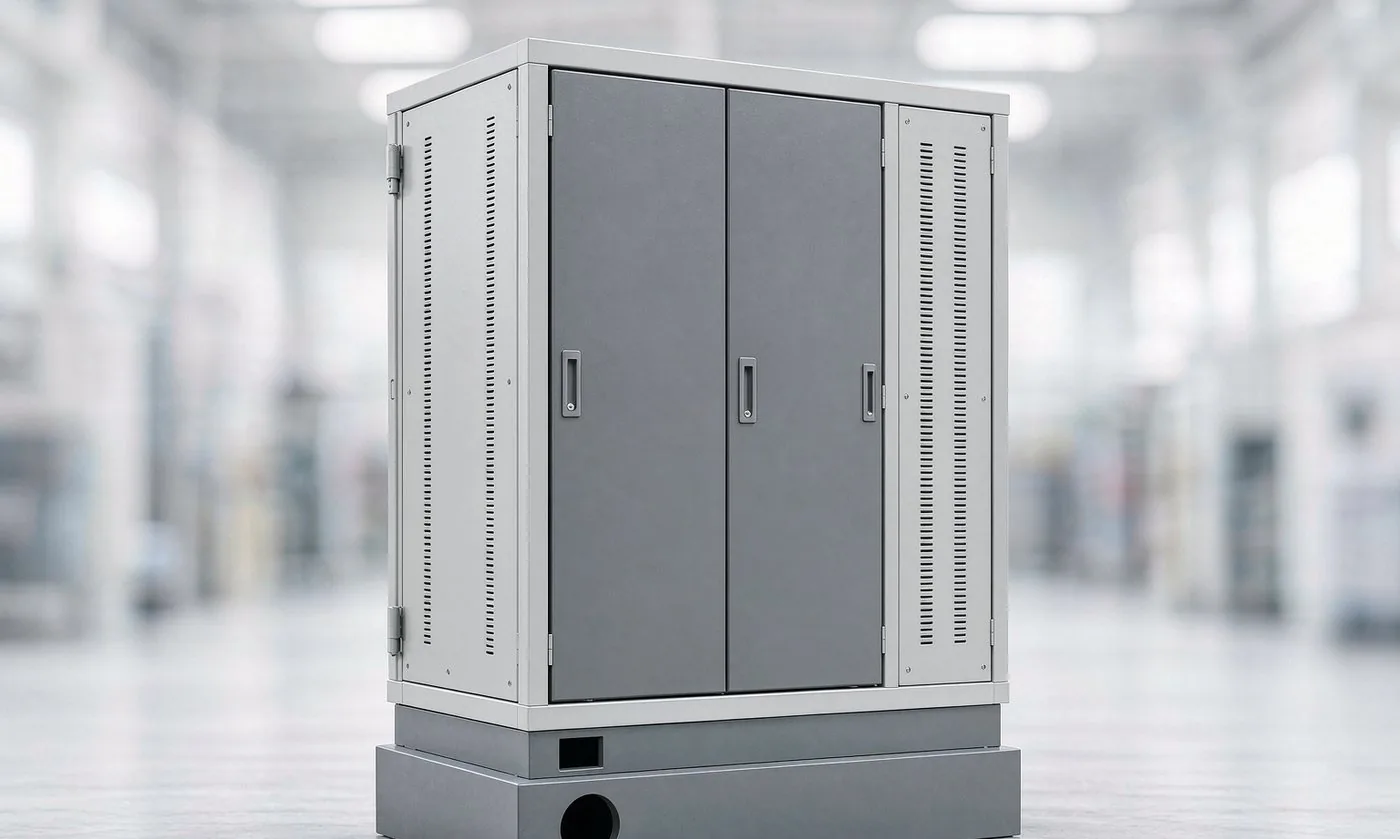
What a Control Panel Enclosure Has to Do
| Function | What it means in sheet metal |
|---|---|
| Contain the devices | A rigid mounting plate and a defined internal volume |
| Protect against the environment | A gasket, sealed entries and a suitable finish |
| Protect people | Doors with positive latching and barriers where specified |
| Let heat out | A defined aperture and mounting face for a cooling device |
| Allow wiring and service | Gland plates, removable panels and sensible access |
| Identify the contents | Labels, markings and the documentation set |
The enclosure is the frame that everything else in the panel is assembled onto, and mistakes in it are paid for by the electrician.
Formats: Wall-Mount, Floor-Standing and Modular
- Wall-mounted enclosures suit small panels and remote installations; the load path runs into the wall, so the mounting bracket and the wall type matter.
- Floor-standing single-door cabinets are the general-purpose choice; depth and door width follow the internal layout.
- Double-door cabinets allow a wide panel without an impractically heavy door; the second leaf needs a defined closing sequence.
- Modular and bayable systems allow extension, with a shared side panel and often a shared busbar and mounting plate.
- Console and desk enclosures combine an operator interface with a control section and need their own ergonomic design.
Frame Construction and Dimensional Discipline
- Keep the mounting plate dimensions, the fixing pattern and the internal depth under control, because they set where every device lands.
- Use a consistent datum, usually the inside face of a side panel or the mounting plate surface, and reference all internal features from it.
- Reinforce the base where the cabinet will be lifted or skidded, and provide lifting points.
- Make side and rear panels removable where the site requires it.
- Where cabinets will be bayed, use a side profile designed for it rather than drilling holes in a flat panel.
Mounting Plates, DIN Rails and Internal Layout
- Provide a standard perforated mounting plate unless the internal layout is fixed, in which case a drilled plate may be more convenient.
- Give the plate a defined position and a repeatable fixing pattern so that pre-assembled sub-panels can be built off-line.
- Allow for DIN rail positions and for the depth of devices mounted on them.
- Leave space for wireways and for the bend radius of the wiring, not just for the devices.
- Where a device has a defined mounting height, such as an operator display, put that height on the drawing.
Gland Plates, Cable Entries and Busbar Openings
- Use removable gland plates in the base, and in the roof where cables enter from above.
- Size the plate for the expected cable count with room for later additions, and provide spare plugged entries.
- Keep power and signal entries separated, with physical barriers where the specification requires it.
- Provide a defined aperture for a busbar trunking entry where cabinets are bayed.
- Protect the entry with a grommet, a brush strip or a gland plate seal so the protection class is not lost at the entry.
Doors, Latching and Protection
- Use multi-point latching on tall doors so the gasket compresses evenly.
- Make the hinge side and the door swing suit the plant layout, and allow the door to be reversed where possible.
- Provide a door stop or a hold-open feature where the door is heavy.
- Design the door-mounted device interface so that devices can be fitted without stressing the door.
- Provide a door earthing bond where the door carries electrical devices.
Thermal Provisions Built into the Enclosure
- Provide a defined aperture and mounting face for the selected cooling device.
- Keep the aperture away from the top of the door where it would fight the natural convection path.
- Provide space for a thermostat, a filter and a shroud if a filter fan is used.
- Where a filter fan is fitted, allow for a matching filtered exit so the air has somewhere to go.
- Consider the internal temperature at the top of the panel, which is where the hottest devices usually sit.
Protection Class and Where It Is Lost
The protection class is usually lost at the details rather than at the door.
- Entries: glands sized and fitted correctly, and gland plates sealed.
- Gaskets: continuous, correctly compressed and not damaged by a latch or a hinge.
- Locks and hinges: each one is a potential path if it interrupts the gasket line.
- Joins between cabinets: a bayed pair has two gaskets and a seal between them.
- Roof apertures: a filter or a fan shroud must seal as well as the panel it replaces.
Finish, Labels and Documentation
- Powder coating is the default, with masked earth and mounting faces.
- Galvanised or stainless where corrosion resistance is the priority.
- Labels for the panel identification, the voltage and the warning notices, applied after coating.
- Documentation including a dimensional record of the mounting plate and the gland plate, and the as-built layout where the project requires it.
First-Article Checks
| Check | Method | Why |
|---|---|---|
| Mounting plate dimensions | Measured against the layout drawing | Every device depends on it |
| Gland plate pattern | Gauge | Wiring and cable alignment |
| Door fit and latching | Open and close test | Serviceability and gasket compression |
| Protection class features | Visual and feeler gauge at the gasket | Water and dust ingress |
| Cooling aperture | Measured against the device drawing | Cooling device fit |
| Earth continuity | Continuity check | Safety |
| Finish and masking | Visual | Bonding and appearance |
Our Approach to Control Panel Enclosures
- We fabricate wall-mount, floor-standing and modular enclosures, doors, mounting plates, gland plates, plinths, internal barriers and cooling apertures.
- We dimension the internal features from a single datum and cut the entries to the buyer's cable schedule rather than to a house pattern.
- We will tell you when a requested internal layout will not fit the enclosure depth once the wiring space and the cooling device are allowed for.
- We do not supply the electrical devices, the wiring, the cooling units or the protection relays, and we do not certify the electrical design or the panel's compliance with any electrical standard.
- Every quotation states which operations are completed in our plant.
Send the internal layout, the cable schedule and the environment, and the enclosure can be built so that commissioning is an assembly job rather than a correction.
Frequently Asked Questions
A control panel enclosure houses control and automation equipment, so its internal layout is dominated by low-voltage devices on DIN rails, a PLC, drives and the wiring between them. A distribution board distributes power, so its layout is dominated by protective devices and busbars. The sheet metal duties are similar, but the internal mounting, the barriers and the thermal load are different, and the two are usually specified separately.
State the protection class together with the environment the panel will live in, because the class is only meaningful against a location. A panel inside a clean, temperature-controlled room and a panel on a wash-down line in a food plant have completely different requirements. It is also worth stating the protection class of the door and of the entry separately, since most failures occur at entries rather than at the door.
Often yes, and it is better to answer that question at the design stage. A sealed enclosure with drives and a transformer inside can run far above the room temperature, and the internal temperature at the top of the panel is what matters for the electronics. Where cooling is needed, the enclosure should provide a defined aperture and mounting face for a filter fan, a heat exchanger or a cooling unit rather than requiring an on-site cut.
A gland plate is a removable section of the enclosure base or roof through which cables enter, fitted with glands. It matters because it lets the panel be assembled and wired without cutting holes in a finished enclosure, and because it can be re-drilled if the cable schedule changes. A solid base with holes drilled into it cannot be corrected once the coating is applied.
Only if it was designed for it. Modular and bayable systems allow adjacent enclosures to be joined, sharing the side panel and sometimes the busbar and the mounting plate. If future extension is likely, say so at the enquiry stage, because baying requires compatible side profiles, fixing points and often a common plinth and depth.
Explore Related Capabilities
- Control Panel Enclosures — PLC, control and automation cabinets
- Electrical Enclosures & Cabinets — Wall-mount and floor-standing cabinets
Have a Drawing to Quote?
Send STEP, DXF or PDF drawings and we reply with engineering feedback and a detailed quotation within 24 hours on working days.