HMI Enclosure Materials and Surface Treatment for Real Environments
HMI Anjue Metal | Industrial | 10 min read | Updated Oct 13, 2026
An HMI sits where the operator is, which is usually the least friendly place in the plant: within reach of coolant, cleaning agents, gloves, sunlight and occasionally a stray tool. The display and the electronics inside are chosen for the job; the enclosure around them has to be chosen for the environment, and the two decisions are usually made by different people.
- What Actually Drives the Material Choice
- Where Aluminium Earns Its Place
- Where Coated Steel Wins
- Surfaces, Textures and Cleaning
- Chemical and Washdown Resistance
- Window and Bezel Materials
- Heat and Sun at the Operator Station
- Bonding, Earthing and EMC Interfaces
- Checks on the Build
- How We Approach HMI Enclosures
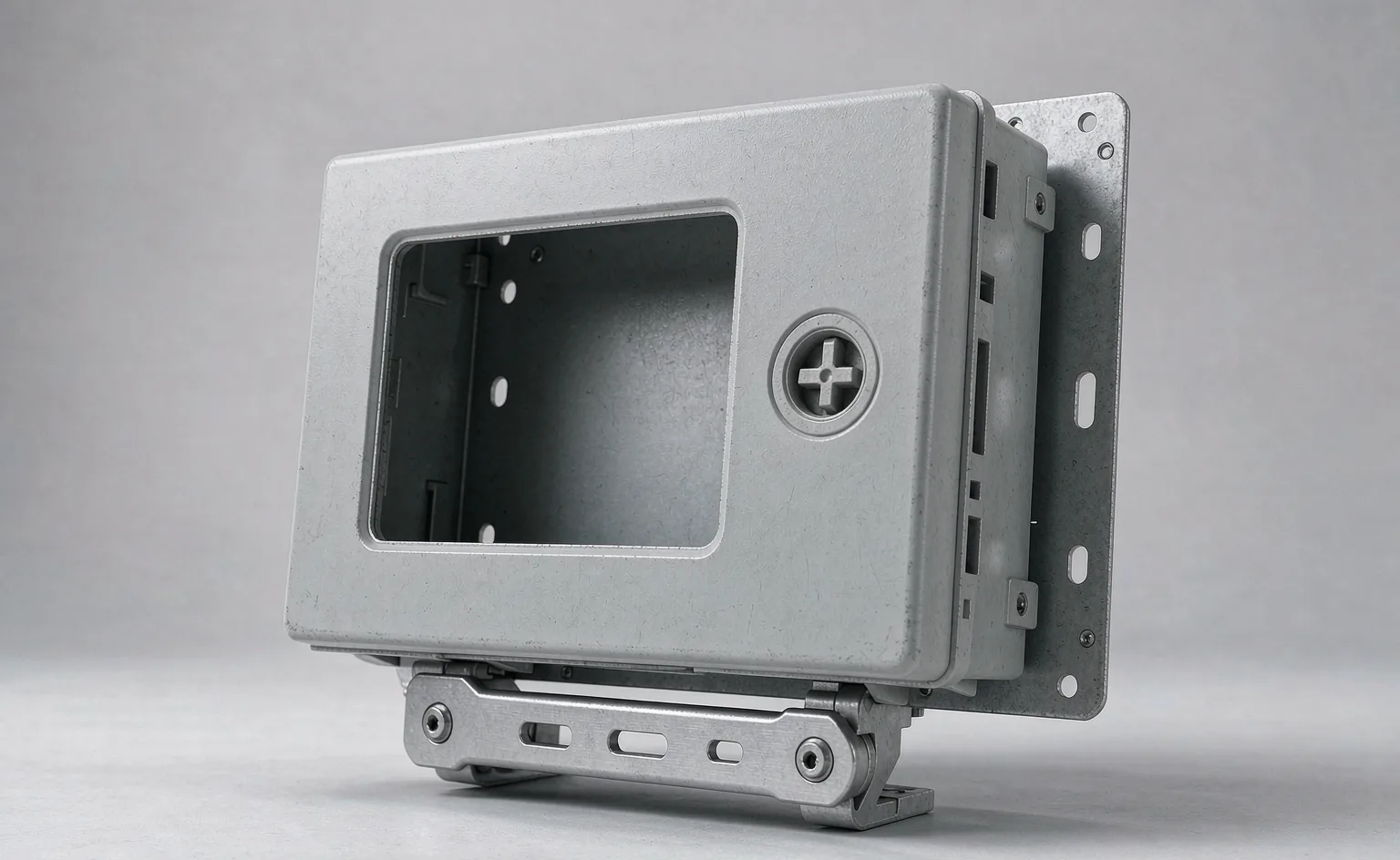
What Actually Drives the Material Choice
| Driver | Points toward |
|---|---|
| Weight and mounting | Aluminium |
| Stiffness at large size and cost | Coated steel |
| Washdown, hygiene, chemicals | Stainless |
| Heat transfer from the enclosure | Aluminium |
| Repairability on site | Steel |
| Appearance and forming detail | Aluminium |
| Cost sensitivity at volume | Coated steel |
Where Aluminium Earns Its Place
- Wall and arm-mounted units where weight loads a bracket or an arm.
- Small, detailed bezels where forming and finish quality matter.
- Applications where the enclosure helps remove heat, since aluminium conducts well.
- Watch galvanic corrosion where aluminium meets a steel or stainless mounting in a wet environment.
- Remember that aluminium is softer, so fixings and threads need more care.
Where Coated Steel Wins
- Pedestal and machine-mounted units where stiffness matters more than weight.
- Larger sizes, where the cost difference becomes significant.
- Environments that damage surfaces, where local repair is likely.
- Choose a coating system to suit the environment, not just the colour.
- Where stainless is chosen, remember that the finish, not just the grade, affects cleaning behaviour.
Surfaces, Textures and Cleaning
- Use a matte or satin finish on the bezel to reduce glare for the operator.
- Avoid glossy surfaces where they will reflect ceiling lights or sunlight.
- Keep surfaces cleanable, without crevices, sharp corners or exposed fasteners that trap dirt.
- Choose fasteners that can be cleaned, or hide them behind a removable trim.
- Where aggressive cleaning agents are used, specify the surface treatment against that list.
Chemical and Washdown Resistance
- List the cleaning agents and the frequency as part of the specification.
- Remember that solvents, chlorinated cleaners and hot water are the hardest cases.
- Choose the coating or the metal accordingly, rather than assuming one finish suits all.
- Protect cut edges and hidden faces, which corrode first.
- Where a window is used, check the window material against the same chemicals.
Window and Bezel Materials
- Choose the window material for impact, chemical exposure and optical quality together.
- Provide a frame that can be replaced in service, so a scratched window does not scrap the unit.
- Keep the sealing between window and bezel as designed; it is one of the hardest joints to keep clean.
- Consider hard-coated windows where the surface will be touched and wiped.
- Where the window is recessed, check that fingers and cloths can reach the whole surface for cleaning.
Heat and Sun at the Operator Station
- Remember that the display and the electronics both generate heat, and that a sunlit panel adds more.
- Provide ventilation or conduction provisions where the load requires them.
- Keep filters accessible if a filtered fan is used, and document the interval.
- Use a light face colour where solar gain is significant, and shade where the site allows.
- Keep the hottest air path away from the display's own cooling.
Bonding, Earthing and EMC Interfaces
- Provide a bonding point and keep the bonding faces masked through finishing.
- Keep joint continuity good at covers and removable panels.
- Provide grounding provisions where the design calls for shielding.
- Remember that a window opening is a break in the shielding, and the design has to account for it.
- Record the bonding points on the drawing for future testing.
Checks on the Build
| Check | Method | Why it matters |
|---|---|---|
| Cut-out against the HMI drawing | Gauge | Unit fits and seals |
| Bezel flatness | Straight edge | Window and seal sit correctly |
| Finish quality and colour | Visual against a sample | Appearance and light reflection |
| Bonding continuity | Continuity check | Earth and EMC |
| Window and seal fit | Fit and visual | Protection and cleaning |
| Fastener type and accessibility | Fit with the specified tool | Cleaning and service |
How We Approach HMI Enclosures
- We fabricate housings, bezels, window frames, mounting brackets, arms and adaptor plates in aluminium, steel and stainless.
- We cut the display and control openings to the component drawings you supply and keep the mounting faces flat.
- We will tell you when a requested finish, a requested cleaning regime and a requested material do not go together as drawn.
- We do not supply the HMI unit, the display, the electronics or the window materials, and we do not certify EMC or the protection class of the finished device.
- Every quotation states which operations are completed in our plant.
Send the HMI datasheet, the cleaning regime and the mounting arrangement, and the enclosure can be chosen for the place it will actually live.
Frequently Asked Questions
Aluminium suits wall and arm-mounted HMIs where weight matters, and it forms neatly and takes a good finish. Steel is stiffer for the same thickness, cheaper for larger sizes and easier to repair locally; coated steel is the usual choice for pedestal and machine-mounted units. In a food, pharmaceutical or washdown environment, stainless is chosen for the surfaces the operator and the cleaning regime actually touch. The answer follows the mounting and the cleaning regime more often than it follows the cost.
One that has been chosen for the specific chemicals in use. Powder coating over a properly prepared surface handles many common detergents well, but strong solvents, chlorinated cleaners and some food-industry agents will attack an unsuitable coating. The right approach is to list the cleaning agents and the frequency, and pick the coating system against that list. No finish should be assumed to be resistant to everything.
Partly with the display and partly with the enclosure. A matte, dark bezel and a recessed or shaded window reduce glare; a glossy bezel will reflect the ceiling and the sun into the operator's eye. Where the panel faces a window, a hood or a slight angle can do more than any change to the finish.
It can. A metal enclosure provides shielding, and its continuity at joints and openings matters as much as its material. Where the panel needs shielding, the grounding and the joint details are part of the design. We provide the metalwork and the bonding points; the EMC performance of the finished device belongs to the equipment designer.
No. We fabricate the enclosure, the bezel, the window frame and the mounting parts. The HMI unit, the display and the electronics are supplied by others and mount to the cut-outs and the mounting features we provide. Every quotation states which operations are completed in our plant.
Explore Related Capabilities
- HMI Enclosures — Operator panel housings and bezels
- Aluminium Enclosures — Lightweight housings with good heat transfer
Have a Drawing to Quote?
Send STEP, DXF or PDF drawings and we reply with engineering feedback and a detailed quotation within 24 hours on working days.