Sheet Metal Surface Finishes Compared: Plating, Coating, Anodising and Passivation
Finishing Anjue Metal | Finishing | 13 min read | Updated Oct 8, 2026
Finish is usually the last line on a drawing and the first thing that fails in service. It also carries a disproportionate share of the cost and almost all of the cosmetic risk. This is a practical comparison of every finish we apply or specify, including where each one breaks down.
- Choosing a Finish in One Page
- Powder Coating: The Default for Good Reason
- Wet Paint: Still the Right Answer Sometimes
- E-Coat: The Best Edge Coverage You Can Buy
- Zinc Plating and Hot-Dip Galvanising
- Anodising Aluminium
- Passivation and Brushed Finishes for Stainless
- What Finishes Actually Add to the Part Price
- A Decision Shortcut
- Finishing at Anjue Metal
Choosing a Finish in One Page
| Finish | Substrate | Outdoor life | Relative cost | Where it belongs |
|---|---|---|---|---|
| Powder coat | Steel, aluminium, galvanised | 5-15 years | Low | General enclosures, cabinets, covers |
| Wet paint | Anything | 3-10 years | Low-medium | Large parts, colour matching, touch-up |
| E-coat (electrophoretic) | Steel | 5-12 years as base | Medium | Complex parts needing edge coverage |
| Zinc plating | Steel | 6-18 months bare | Low | Small brackets, indoor hardware, base for paint |
| Hot-dip galvanising | Steel | 20-50 years | Medium | Structural posts, ground-mounted cabinets |
| Zinc-nickel / trivalent plating | Steel | 2-5 years | Medium-high | Automotive-grade, high corrosion specs |
| Anodising | Aluminium | 10-20 years | Medium | Visible aluminium, heat sinks, bezels |
| Passivation | Stainless | Extends life significantly | Low | After welding or machining stainless |
| Brushed / No.4 / BA | Stainless | Unchanged surface | Low | Cosmetic stainless panels |
| Chromate / conversion coat | Aluminium | Months to 2 years | Low | Paint base for aluminium |
Powder Coating: The Default for Good Reason
Powder coat sprays electrostatically charged polymer powder onto a prepared substrate and cures it in an oven. It is tough, available in any RAL colour, and produces a thicker film than wet paint in one pass.
What it does well
- Thick, uniform film: typically 60-100 micrometres, versus 25-40 for wet paint.
- No solvents, so it is easier to comply with environmental rules.
- Excellent impact and abrasion resistance for the money.
- Colour and gloss control is straightforward, and matte, satin and textured variants are all available.
Where it fails
- Edges. Powder thins at sharp laser-cut edges, and this is where rust starts. A deburred or radiused edge outperforms a sharp one by a wide margin. If a part will be outdoors, radius or break the edges.
- Corners and recesses. Faraday cage effects mean recessed areas can get a thin film. Deep returns and closed boxes need a conductive hook and sometimes a manual touch-up.
- Pretreatment is the whole game. A seven-stage iron or zinc phosphate pretreatment gives years more life than a simple wash. Cheap powder coat on poorly cleaned steel fails in one season regardless of powder brand.
- Repairability. Chipped powder coat is hard to touch up invisibly; wet paint is easier.

Wet Paint: Still the Right Answer Sometimes
Wet paint still wins in three situations:
- Very large parts that will not fit a curing oven.
- Touch-up and repair on site - a small tin of matched paint is a real operational advantage.
- Special effects such as metallic, hammertone or a specific gloss the powder range does not cover.
The trade-offs are lower film build per pass, solvent handling, and generally lower abrasion resistance than powder. For a colour-matched patch job, nothing else is as practical.
E-Coat: The Best Edge Coverage You Can Buy
Electrophoretic coating submerges the part in a paint bath and uses electrical current to deposit paint. Because the paint follows the electric field, it reaches inside seams, into closed sections and around sharp edges with a uniformity that spray processes cannot match. It is normally applied as a primer under powder or wet topcoat.
Use it when the part is complex and corrosion-driven: welded assemblies, parts with internal cavities, or anything where edge rust would be visible. It adds a process step and cost, so it is not the default for simple flat panels.
Zinc Plating and Hot-Dip Galvanising
These are sacrificial coatings - the zinc corrodes instead of the steel.
| Property | Zinc plating (electroplated) | Hot-dip galvanising |
|---|---|---|
| Coating thickness | 5-25 micrometres | 45-85 micrometres |
| Process | Electrochemical, room temperature | Immersion in molten zinc at about 450 C |
| Appearance | Bright, smooth, precise | Grey, spangled, slightly rough |
| Effect on dimensions | Minimal | Significant build-up; threads need over-tapping |
| Edge protection | Moderate | Excellent |
| Outdoor life | Months to a few years | Decades |
| Best for | Small brackets, indoor parts, paint base | Structural, ground-contact, long-life outdoor |
Two practical warnings. Hot-dip galvanising warps thin sheet - it is unsuitable below about 3 mm unless the part is designed for it, and it will distort thin welded panels. And galvanised surfaces are difficult to powder coat unless they are properly pretreated, because outgassing from the zinc during curing causes pinholes and blistering. Galvanneal or a two-coat system (e-coat plus powder) is the reliable route.
Anodising Aluminium
Anodising grows an oxide layer out of the aluminium itself, so it cannot chip off like a coating. Type II anodising builds roughly 5-25 micrometres and takes dye well; Type III hard anodising builds 25-50 micrometres and is much more wear resistant.
- Type II clear or coloured: appearance parts, bezels, front panels.
- Type III hard: sliding surfaces, wear plates, parts that get handled constantly.
- Anodising must be done before any forming operation that would crack the oxide, or the oxide cracks at the bend. Form first, anodise second.
- Unlike paint, anodising does not hide surface scratches. If the aluminium is scratched before anodising, the scratch stays visible. Cosmetic aluminium parts need protective film throughout processing.
Passivation and Brushed Finishes for Stainless
Stainless protects itself with a chromium oxide layer, and welding destroys that layer locally. Passivation removes free iron and embedded contamination and lets the oxide re-form - it is not a coating, and it does not change dimensions.
- Essential after welding 316L, and after any machining or brushing that could embed carbon steel particles.
- Citric acid passivation is common and milder than nitric, and is usually sufficient for architectural and enclosure work.
- Brushed (No.4), hairline and BA finishes are cosmetic and mechanical; they do not replace passivation. A brushed stainless part with a brushed weld can still rust if the weld was not cleaned properly.
Note · The most common stainless failure we see is not a material problem. It is a weld that was never cleaned, or a part brushed with a carbon steel brush elsewhere in the shop. Both look like "the stainless rusted" and neither is the grade's fault.
What Finishes Actually Add to the Part Price
| Finish | Typical share of finished part cost | Notes |
|---|---|---|
| No finish, deburred only | 0% | Laser-cut and formed parts |
| Zinc plating | 3-8% | Cheapest corrosion protection |
| Powder coat, one colour | 8-18% | Includes pretreatment and oven cure |
| Wet paint | 8-20% | Higher labour on large parts |
| E-coat plus powder | 15-25% | Best edge protection |
| Hot-dip galvanising | 10-20% | Cheap per square metre, heavy build-up |
| Anodising Type II | 10-20% | Cleaning and masking add cost |
| Hard anodising Type III | 18-30% | Longer cycle, tighter process control |
| Passivation | 3-8% | Cheap insurance on welded stainless |
Cost is driven more by part preparation and racking than by the material of the finish itself. A part that needs masking, plugging of threads, or a custom rack costs more to coat than the coating costs.
A Decision Shortcut
- Indoor electronics housing, cosmetic priority: powder coat, standard colour, deburred edges.
- Outdoor cabinet, moderate climate: galvanised steel plus powder coat, or e-coat plus powder on cold-rolled.
- Coastal or coastal-adjacent: 304 stainless with passivation, or 316L if chlorides are heavy.
- Structural, ground-mounted, decades of life: hot-dip galvanised steel.
- Visible aluminium product: Type II anodising after forming.
- Welded stainless assembly: passivation, without exception.
Finishing at Anjue Metal
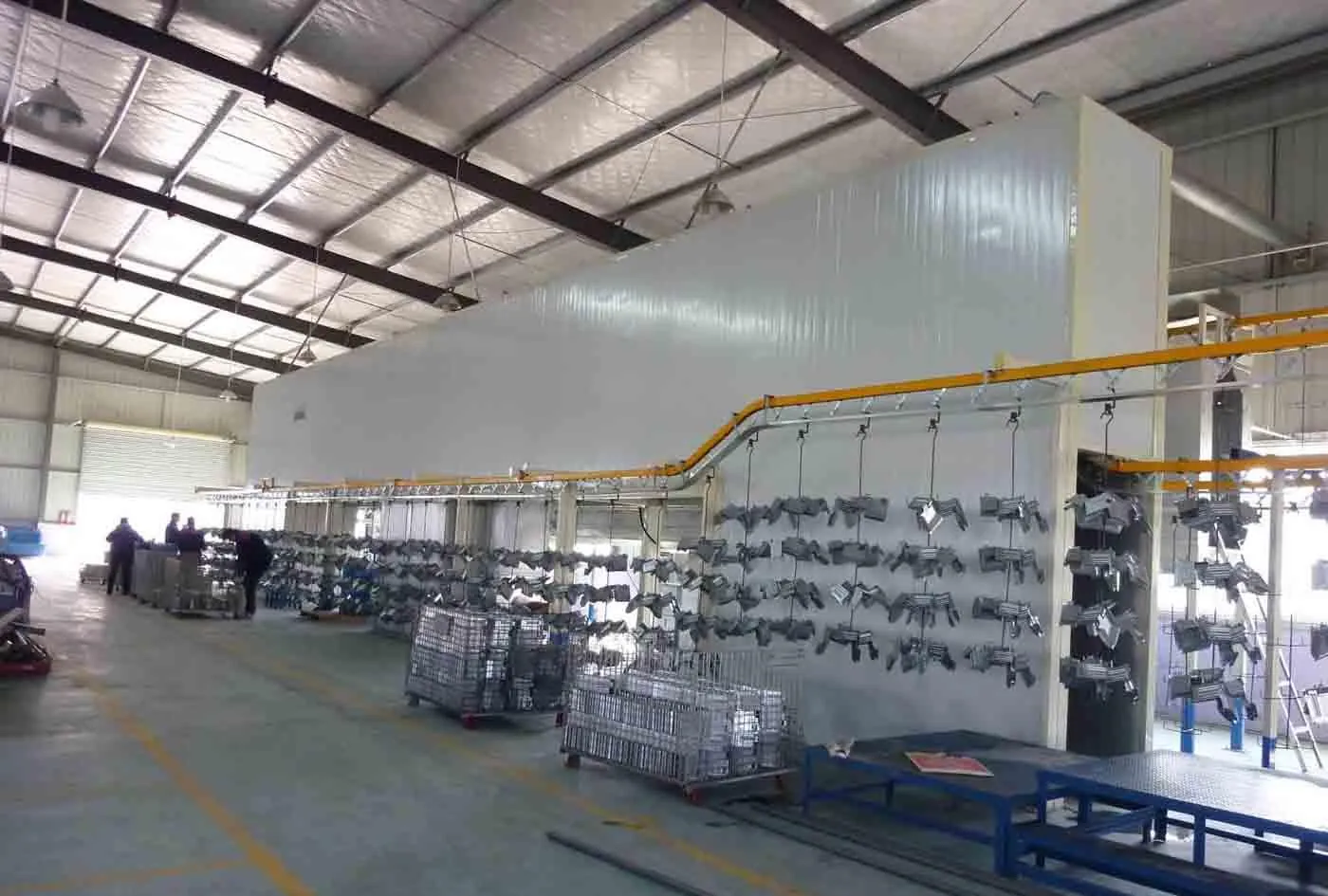
- In-house powder coating with multi-stage pretreatment, standard and textured finishes, RAL colour matching.
- Deburring, edge breaking and radius on outdoor-bound parts as standard practice, because that is where coating fails first.
- Hot-dip galvanising, zinc plating, anodising and passivation arranged with qualified finishing partners, with the process specified on the traveller rather than left to the shop floor.
- Sheet steel from 0.5 to 8.0 mm, up to 3000 x 1500 mm, in cold-rolled, galvanised, aluminium, and 304 / 316L stainless.
Frequently Asked Questions
For most enclosures, yes - powder gives a thicker film in one pass, better impact and abrasion resistance, and no solvents. Wet paint still wins where parts are too large for an oven, where on-site touch-up matters, or where a special effect such as metallic or hammertone is required.
Because powder film thins over a sharp laser-cut edge during cure, leaving a weak point where moisture reaches bare steel first. Deburring or radius the edges before coating; the cost is small and the improvement in outdoor life is significant.
It can be done but needs proper pretreatment and often an e-coat or primer layer, because zinc outgasses during the cure cycle and causes pinholes and blistering. Galvanneal, or hot-dip galvanising left bare, is usually the more reliable choice.
Anodising works best on 5000 and 6000 series alloys, which is what most sheet metal enclosures use. High-copper 2000 series and high-silicon casting alloys anodise poorly and often come out dark or patchy. Tell us the alloy before specifying anodising, and always anodise after forming.
Not for a plain formed part, but yes after welding or any operation that could embed free iron. Passivation removes contamination and lets the chromium oxide layer re-form. Without it, stainless welds commonly show rust streaks within a season, which is a cleaning problem rather than a material problem.
Explore Related Capabilities
- Powder Coating Service — Multi-stage pretreatment and RAL colour matching in house
- Stainless Steel Fabrication — 304 and 316L parts with passivation after welding
Have a Drawing to Quote?
Send STEP, DXF or PDF drawings and we reply with engineering feedback and a detailed quotation within 24 hours on working days.