How to Reduce Sheet Metal Part Cost: Twelve Levers That Actually Work
Cost Anjue Metal | Cost | 12 min read | Updated Oct 8, 2026
Asking a supplier for a discount is the least effective cost lever available. The real savings are in the drawing, the tolerance callouts, the finish specification and the batch structure - decisions that are yours to make and that cost the supplier nothing to honour.
- Cost Is Built at the Machine, Not Negotiated at the Table
- Lever 1: Use the Right Material, Not the Best Material
- Lever 2: Re-examine Thickness After the Geometry Is Fixed
- Lever 3: Count the Operations, Not the Features
- Lever 4: Rationalise Tolerances
- Lever 5: Improve Material Utilisation
- Lever 6: Simplify the Finish
- Lever 7: Structure the Order Around the Process Economics
- Lever 8: Simplify the Hardware Set
- Lever 9: Design Out the Welding
- Lever 10: Look at the Landed Cost, Not the Unit Price
- Lever 11: Use DFM Review as a Free Engineering Service
- Lever 12: Standardise Across the Product Family
- The Effective Order of Attack
- How We Support Cost Reduction
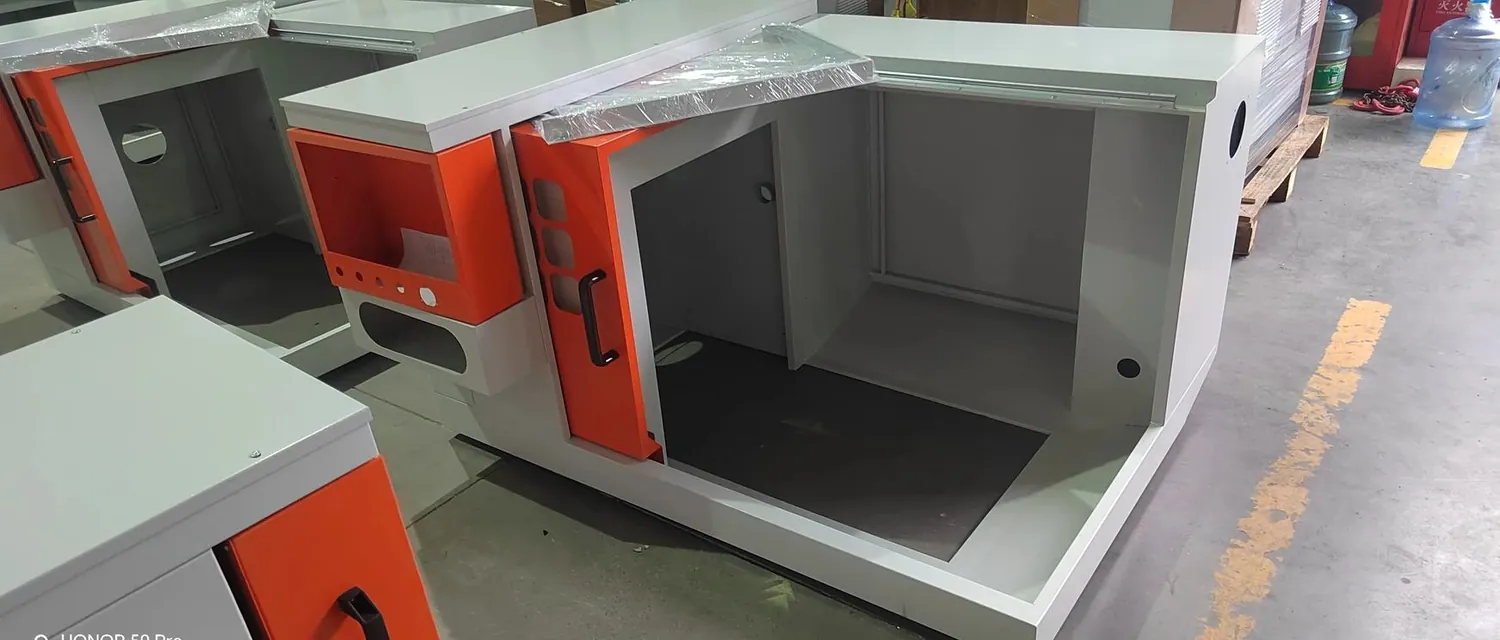
Cost Is Built at the Machine, Not Negotiated at the Table
A sheet metal part's price is the sum of material, machine time, labour, finishing, hardware and overhead. Of those, only overhead and margin are negotiable. Everything else is set by the drawing.
That means the highest-value conversation with a supplier is not "can you do better on price" but "which of these features is costing me money, and what would you change". A good factory will answer that question honestly, because a simpler part is easier for them too.
Lever 1: Use the Right Material, Not the Best Material
- Do not specify 316L for an indoor part. 304 or powder-coated steel will do the same job for less.
- Do not specify stainless where galvanised steel with a coating will serve. Stainless typically costs multiples of galvanised steel per kilogram.
- Match the grade to the form. 5052 aluminium forms cleanly; 6061-T6 cracks at tight radii and may force a larger bend radius or a different temper.
- Check whether your corrosion requirement is real. Ask where the product actually goes. Coastal and washdown sites deserve 316L; a dry indoor plant room does not.
Material substitution is usually the single largest lever, but it must be argued from the application, not from the price list.
Lever 2: Re-examine Thickness After the Geometry Is Fixed
Thickness affects material cost, forming force, weld time, weight and freight. Two things to check:
- Is the thickness driven by stiffness or by strength? If stiffness, a formed flange or rib will let you drop a gauge.
- Is the thickness a legacy from an earlier design that had a different span or a different mounting arrangement?
Dropping a panel from 2.0 mm to 1.5 mm with an added flange reduces material by about a quarter and reduces component weight, while often increasing panel stiffness. See the thickness selection guide for the span rules we use.
Lever 3: Count the Operations, Not the Features
Every operation has a setup, a handling time and a scrap risk. A part with 4 operations can easily be cheaper than a part with 3 if the 3-operation version needs a special tool or a repositioning.
- Combine features into one station where possible: a laser cut can produce holes, slots, engraving and part numbering in a single pass.
- Avoid features that require a second setup on a different machine.
- Avoid folding sequences that require the part to be turned over more than necessary.
- Reduce the number of separate parts: a folded bracket that replaces three welded pieces saves welding, fixturing, inspection and inventory.
Lever 4: Rationalise Tolerances
Tolerances are the most common hidden cost, and the most common cause of avoidable rework.
| Callout | If you tighten it, what happens |
|---|---|
| General +/-0.5 mm | Little effect on cost |
| +/-0.2 mm on a bent feature | Needs tighter process control, may add an inspection step |
| +/-0.05 mm on a formed part | Generally not achievable; invites rework or scrap |
| Angle to 0.1 degree | Needs a coining or secondary operation |
| Flatness 0.3 mm over 500 mm | Needs fixturing, sequence planning, maybe a different weld process |
| Ra 0.8 on a laser edge | Adds a finishing operation |
The rule we give designers: put a tight tolerance on the dimension that actually functions - the hole that locates a mating part, the face that seats against a gasket - and use a general tolerance block for everything else. On a typical enclosure this reduces the number of inspected dimensions from dozens to three or four, with no loss of function.
Note · A quick test. For every tight tolerance on your drawing, ask which downstream operation would fail if it were loosened to the general block. If you cannot name one, loosen it. This one exercise routinely identifies 5-15% of avoidable cost.
Lever 5: Improve Material Utilisation
Laser and punch nests cut parts from a standard sheet; the leftover is scrap you still pay for.
- Nest family parts together. If a product family has a bracket that appears on five variants, nesting them together fills the sheet.
- Design part outlines that tessellate. Two mirror-image parts can share a boundary and interlock in the nest.
- Stay on standard sheet sizes. 3000 x 1500 mm and 2500 x 1250 mm are common; a part that leaves an unusable 150 mm strip wastes the whole strip.
- Be willing to share a nest across part numbers. If you order three part numbers together, the supplier can nest them on one sheet instead of running three.
Material utilisation on a well-designed enclosure nest often runs 75-85%. On a badly designed single part it can fall below 60%, which is a 25% material penalty on the whole part.
Lever 6: Simplify the Finish
Finishing is where labour hides.
- One finish per part. Two-tone or masked areas mean extra handling and masking labour.
- Avoid unnecessary masking. If a thread must stay clean, a plug is cheaper than full masking if the geometry allows it.
- Choose a standard RAL colour rather than a custom match; custom colours may need a minimum powder quantity.
- Deburr only where it matters. But be careful: for outdoor parts, edge deburring is where corrosion resistance actually comes from, so it is a poor place to save.
- Consider whether the finish is required at all on internal parts that will never be seen - a phosphated or zinc-plated bracket is cheaper than a powder-coated one.
Lever 7: Structure the Order Around the Process Economics
| Order structure | Effect on unit price |
|---|---|
| Single prototype | Highest - setup and programming dominates |
| 3-10 pieces | High - setup amortised over very few parts |
| 50-200 pieces | The first genuinely efficient band |
| 500+ pieces | Setup becomes negligible; material and machine time dominate |
| Annual blanket with releases | Best - material bought once, tooling amortised, capacity reserved |
Two practical moves:
- Order spares with the production run. The 5% extra units in the same batch cost far less than a separate small order later.
- Consolidate part numbers. Ten different brackets ordered separately cost ten setups; the same ten ordered together share one.
Lever 8: Simplify the Hardware Set
- One thread size for the whole product.
- One screw length wherever possible.
- Clinch fasteners instead of through-bolts where the load allows - fewer holes, less assembly, better sealing.
- Avoid captive screw assemblies unless the field service requirement demands them; they are significantly more expensive per piece.
Lever 9: Design Out the Welding
Welding costs machine time, labour, fixturing, distortion risk, finishing labour and inspection.
- A tab-and-slot joint with two spot welds replaces a fixtured full weld.
- A folded return flange can replace a welded stiffener.
- A hemmed edge replaces a welded edge and removes a sharp edge at the same time.
- Riveted or clinched assemblies often beat welded ones for parts that never see a gasket.
Lever 10: Look at the Landed Cost, Not the Unit Price
For imported parts, unit price is only part of the story.
- Freight and volumetric weight. A design that nests and stacks well ships cheaper.
- Duty and tariff treatment for the HS code your product falls under.
- Packing cost. Custom crates for awkward assemblies can cost more than the part.
- Inventory carrying cost. A longer, slower supply chain needs more buffer stock.
- Quality cost. Rework and sorting are rarely visible in the unit price but very visible in the total.
Lever 11: Use DFM Review as a Free Engineering Service
A factory that reads drawings all day sees cost patterns across hundreds of products. That perspective is free if you ask for it.
- Send the drawing with the application described, not just the geometry.
- Ask explicitly: "which three changes would reduce the price most, and what would each save".
- Ask what tolerance, material or finish they would choose if they were making it for themselves.
A good supplier will answer. If yours will not, that itself is useful information.
Lever 12: Standardise Across the Product Family
The compounding saving is standardisation.
- One material thickness across a family instead of four.
- One finish, one colour.
- One hardware kit.
- Common mounting hole pattern, so one bracket serves three products.
- Shared sheet nest, so parts for several products come off one sheet.
Standardisation reduces setups, inventory lines, inspection plans and the chance of assembly error - and it is free.
The Effective Order of Attack
| Priority | Lever | Typical saving |
|---|---|---|
| 1 | Rationalise tolerances | 5-15% |
| 2 | Optimise material and thickness | 10-25% |
| 3 | Improve nesting and order structure | 5-20% |
| 4 | Reduce operations and welding | 5-15% |
| 5 | Simplify finishing and hardware | 3-10% |
| 6 | Volume structure and blanket orders | 5-15% |
| 7 | Negotiating unit price | 0-5% |
Notice where negotiation sits. It is the last lever, not the first - and everything above it makes the part genuinely cheaper rather than just less profitable for the supplier.
How We Support Cost Reduction
- Every quotation includes a DFM review that names the features costing you money and what to change.
- We quote alternative material and thickness options where a cheaper combination meets the same requirement.
- Nesting is planned across part families, and we tell customers when combining orders would reduce their unit price.
- We will state plainly when a tolerance or finish on a drawing is unachievable or unnecessary, rather than pricing in the rework and shipping it anyway.
Frequently Asked Questions
Rationalise the tolerances. Put tight tolerances only on the dimensions that actually function and use a general tolerance block for everything else. On a typical enclosure this removes most of the inspected dimensions and can reduce cost by 5-15% without changing the design at all.
Margin is only a small part of a fabricated part's price, so discounts are limited. Material, machine time, labour, finishing and hardware make up the bulk, and those are set by the drawing and the order structure. Changing the design or the order structure moves the price far more than negotiating.
Usually, but not always. Thinner sheet can need more forming operations, may not hold the flatness requirement, and may need stiffening that adds parts and welding. Compare the total process, not the raw material line. A thinner panel with a formed rib often wins on both cost and stiffness.
Setup, programming, tooling and fixturing are fixed costs, so they dominate at low volumes and become negligible at high volumes. Practically, pricing improves sharply from one-off to about 50-200 pieces, then improves more slowly. An annual blanket order with scheduled releases gives the best unit price because material can be bought once.
Sometimes. Using one standard colour, avoiding masked or two-tone areas, and not coating internal parts that will never be seen all reduce labour. But do not cut edge deburring on outdoor parts - that is where coating adhesion and corrosion resistance come from, and it is one of the few finishing steps that genuinely earns its cost.
Explore Related Capabilities
- Sheet Metal Prototyping — Validate a cost-reduced design before committing to tooling
- Precision Metal Parts — Brackets, plates and formed components quoted from drawing
Have a Drawing to Quote?
Send STEP, DXF or PDF drawings and we reply with engineering feedback and a detailed quotation within 24 hours on working days.