How Sheet Metal Fabrication Cost Is Really Calculated (Line by Line)
Cost Anjue Metal | Cost & Pricing | 12 min read | Updated Oct 8, 2026
Two suppliers quote the same drawing and the numbers differ by 40%. One of them is wrong - or one of them is quoting a different product. This article opens up the calculation so you can read a quotation critically, compare suppliers fairly, and know which design changes actually save money.
The Seven Lines Behind Every Quotation
| Line | What drives it | Typical share of part cost |
|---|---|---|
| 1. Material | Grade, thickness, sheet size, nesting yield | 30-55% |
| 2. Setup and programming | Number of unique parts, laser nests, press brake programs | 5-15% (higher on small batches) |
| 3. Cutting | Contour length, thickness, hole count, tolerance | 10-25% |
| 4. Bending | Number of bends, part size, angle tolerance | 5-15% |
| 5. Welding and assembly | Weld length, joint prep, hardware, sub-assembly | 5-25% |
| 6. Finishing | Finish type, total surface area, masking, colour changes | 8-20% |
| 7. Packaging and handling | Protection level, carton or crate, palletising | 2-8% |
If a quotation does not break cost down into at least material, process, finishing and packaging, you cannot compare it to another quote. Ask for the split.
Material and Nesting Yield - The Biggest Lever
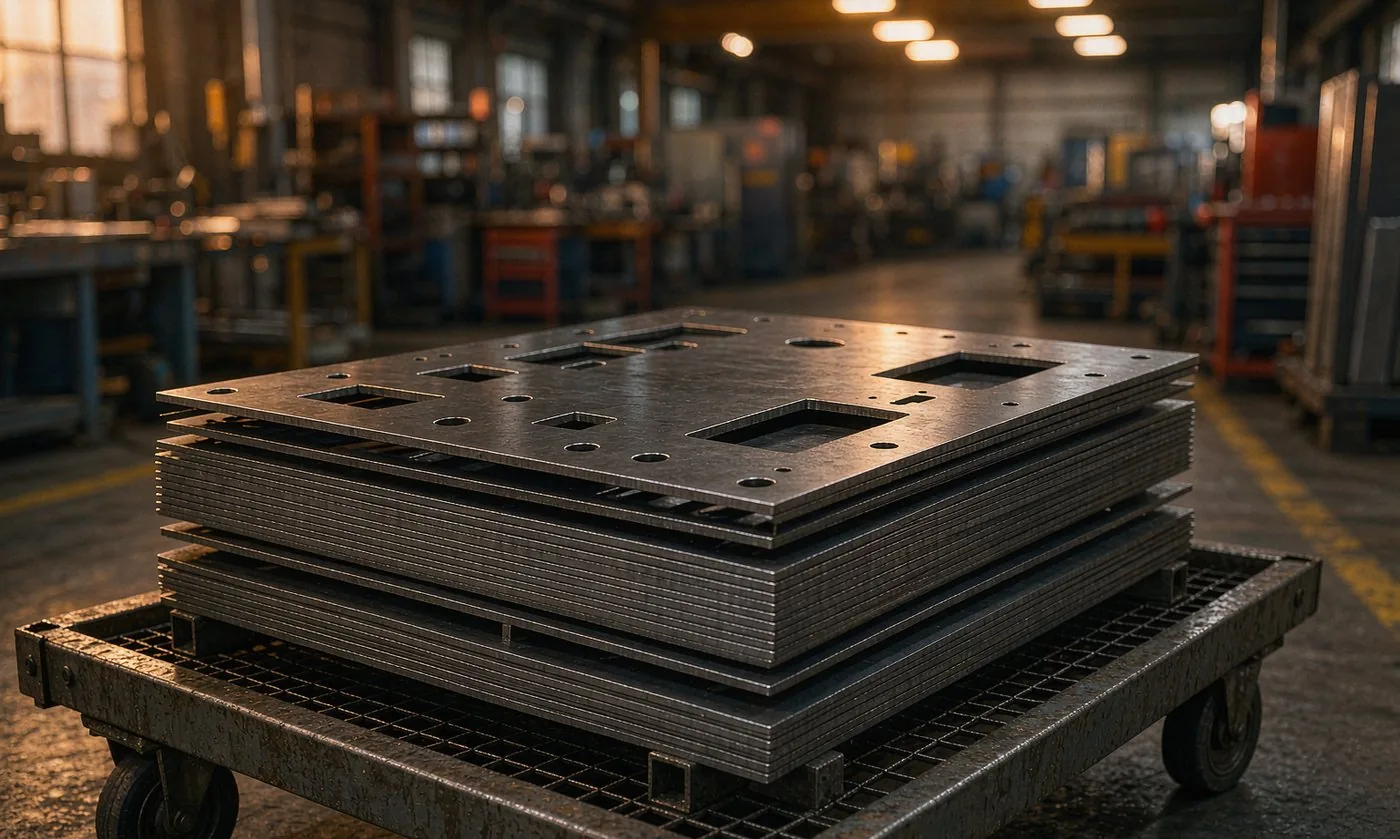
Material is the largest single line, and the part of it that buyers underestimate most is yield.
When parts are nested onto a 3000 x 1500 mm sheet, some of the sheet becomes skeleton scrap. A part that tiles efficiently might use 85% of the material; an awkward, long, thin part might use 55%. The cost difference is enormous - and it is invisible on a drawing.
Practical ways to cut material cost:
- Design parts to tile. Rectangular profiles and consistent part families nest far better than irregular outlines.
- Avoid unnecessary cut-outs that remove material you are still paying for.
- Standardise thickness across a product family. Buying one heavier gauge for everything is often cheaper than stocking three gauges for marginal weight savings.
- Consider the skeleton. If two parts in the same project can share a sheet, the offcuts can be consumed rather than scrapped.
Material price also moves. Steel and aluminium are quoted with surcharges that change monthly, which is why a quotation typically carries a validity window - ours is 30 days.
Cutting Cost: Contour, Holes and Thickness
Laser cutting is charged essentially by machine time, which is driven by:
- Total cut length (perimeter of every contour, plus every hole)
- Thickness - cutting time rises sharply with thickness, roughly non-linearly
- Material - stainless and aluminium are slower than mild steel at equal thickness
- Nitrogen vs oxygen assist - nitrogen gives cleaner edges on stainless and aluminium at higher gas cost
- Hole density - a panel with 300 small holes costs far more than a plain panel of the same outline
This is why a perforated vent panel is disproportionately expensive compared with its simple appearance. If a design has large areas of small holes, ask whether a punched or expanded-mesh insert would do the same job.
Bending Cost
Bending is charged per bend plus handling time. The handling time depends on part size: a small bracket is quick, a 2 m cabinet side panel is not.
Cost rises with:
- Bend count and bend complexity (folds in multiple planes)
- Part size and weight
- Tolerance: a general ±0.5 degree angle tolerance costs less than a ±0.1 degree requirement
- Special tooling needs - unusual radii or deep box shapes may require dedicated tooling
A design refinement worth knowing: replacing two bends with one hem, or eliminating a bend that exists only for appearance, is one of the cheapest possible savings.
Welding and Assembly
This line varies more than any other, because it reflects manual labour:
- Weld length - grinding and finishing welds on visible stainless can cost more than the weld itself
- Joint design - a flange designed for a lap weld is quicker and stronger than a butt joint needing fit-up
- Hardware count - pressed-in nuts, studs, standoffs and inserts each add a press operation and handling
- Sub-assembly scope - doors, hinges, locks, gaskets, cable management and labelling
- Fit-up quality - parts that are formed accurately assemble quickly; parts that are not consume an hour of persuasion
Well-designed parts are not just cheaper to weld - they are also more repeatable, which reduces the risk of quality escapes.
Finishing Cost: Area, Masking and Colour
Surface finishing is priced mostly by surface area and complexity:
- Powder coating: area plus a colour change allowance. Small batches in unique colours carry a premium because of the changeover.
- Anodizing: area plus racking cost, which rises with part count and awkward geometry.
- Plating: area, plus barrel or rack handling.
- Masking: threaded holes, mating surfaces and electrical contact points often need masking, which is manual work.
If your product is available in six colours, understand that this multiplies cost across batches. Consolidating to two or three high-volume colours and treating others as specials usually saves more than it costs in lost variety.
How to Read a Quotation Critically
- Check what is excluded. Freight, duty, tooling, certificates and packaging are frequently excluded. Compare delivered totals.
- Check the material basis. Ask whether the material price reflects the current month's surcharge and what the quotation validity is.
- Check the tolerance and finish assumptions. A cheap quote often assumes a looser tolerance and a standard finish than your drawing requires.
- Check the quantity basis. Price per part falls steeply from 1 to 100 pieces and flattens after that. Comparing a 10-piece quote against a 1,000-piece quote tells you nothing.
- Check the minimum charge. Small orders are often priced on a minimum, so a 5-piece order may carry nearly the same price as a 30-piece order.
Where Design Changes Save the Most Money
| Change | Typical saving | Comment |
|---|---|---|
| Reduce unique part count | High | Fewer setups, fewer drawings, fewer inspection points |
| Standardise material grade and thickness | High | Better nesting, simpler purchasing |
| Loosen non-critical tolerances | Medium-High | Cheaper process route, less scrap |
| Replace small-hole arrays with inserts | Medium | Cutting time falls sharply |
| Reduce visible weld finishing | Medium | Grinding labour is expensive |
| Avoid very tight bend radii | Medium | Standard tooling, fewer rejects |
| Consolidate powder coat colours | Low-Medium | Fewer changeovers |
| Simplify packaging | Low | Better for mature products |
The most valuable conversation you can have with a supplier happens before you order - send the drawing with the target quantity and ask "what would you change to reduce cost without affecting function?" A good factory will answer with two or three specific suggestions. A trading intermediary will not.
Frequently Asked Questions
Material, including how efficiently the part nests on the sheet. It typically accounts for 30-55% of part cost. Cutting time is second, driven by total contour length and thickness.
Because setup - programming, laser nesting, press brake programs, first-article inspection - is spread across fewer parts. Price per part falls steeply up to a few hundred pieces and then flattens.
For standard folding and laser cutting, no dedicated tooling is required. If a drawing needs a special press brake tool or a custom die, we quote it separately and confirm it with you before starting.
Our quotations carry a 30-day validity, because steel and aluminium prices move with monthly surcharges. After that we re-confirm material pricing.
Often yes. Tell us the target and the quantity and we will tell you honestly which design changes would reach it - reducing part count, relaxing a tolerance, or changing a finish are the usual levers.
Explore Related Capabilities
- Precision Sheet Metal Parts — Laser cutting, prototypes, brackets and panels
- Custom Sheet Metal Enclosures — OEM electronics housings built to drawing
Have a Drawing to Quote?
Send STEP, DXF or PDF drawings and we reply with engineering feedback and a detailed quotation within 24 hours on working days.