Specifying an Outdoor Telecom Cabinet: Ratings, Cooling and Serviceability
Telecom Cabinets Anjue Metal | Telecom | 11 min read | Updated Oct 12, 2026
Most telecom cabinet projects that go wrong do so at the specification stage rather than on the shop floor. The requirement is written as a set of words that sound like a specification, the cabinet is built to the words, and the gap only appears when it is installed on a street corner. This guide is about closing that gap before the drawing is issued.
- Start from the Site, Not the Cabinet
- IP Ratings and What They Do Not Cover
- Choosing a Cooling Strategy
- Structural and Environmental Loads
- Earthing, Lightning and Cable Entry
- Access Strategy and Security
- Materials and Coating by Environment
- What to Put in the RFQ
- Acceptance Checks
- Our Approach to Specifications
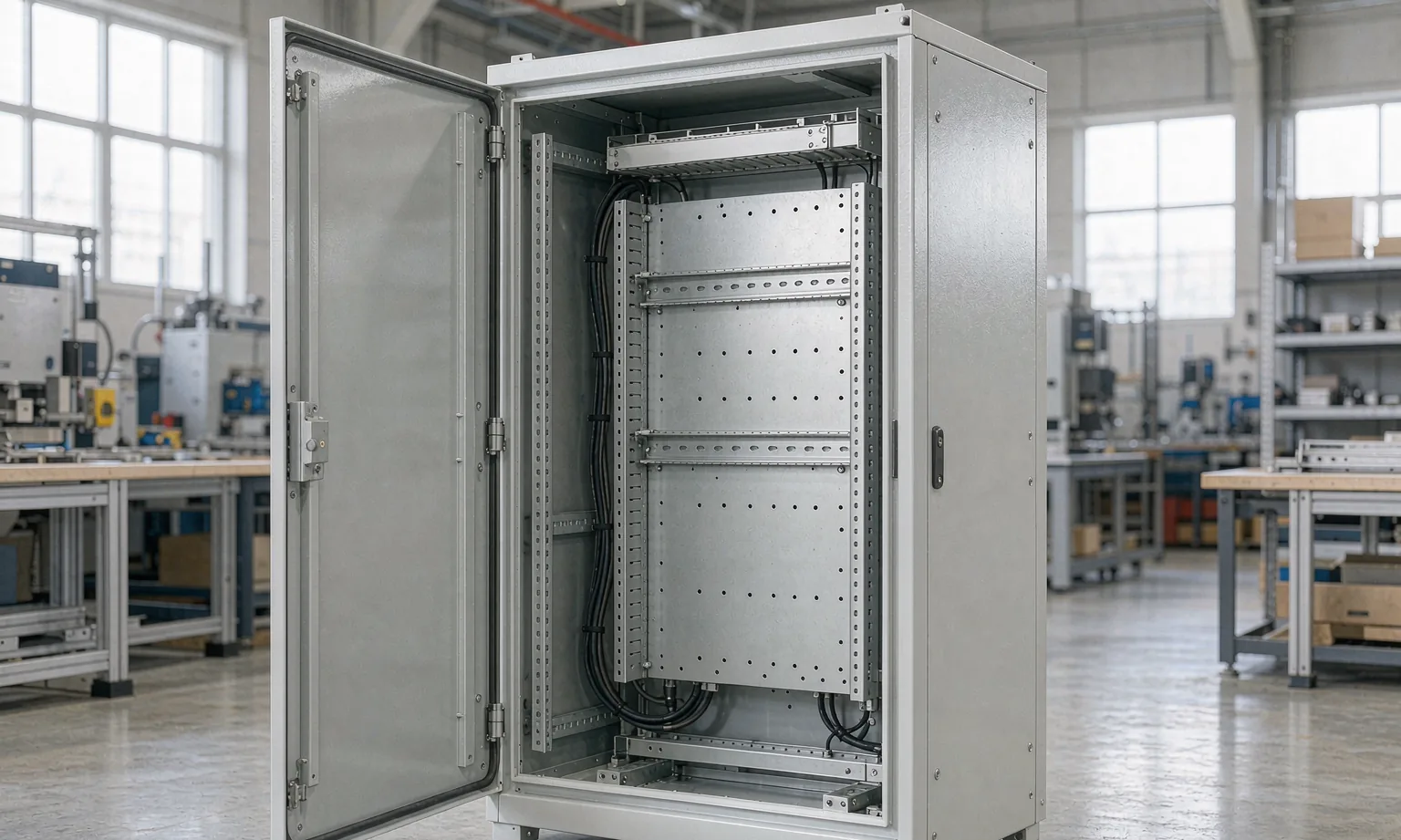
Start from the Site, Not the Cabinet
| Site question | Why it matters | What it drives |
|---|---|---|
| Exposure: rain, sun, dust, salt | The real environment | IP target, coating system |
| Access: who, how often, from where | Service and safety | Door and rack arrangement |
| Power and battery backup | Heat and mass | Thermal zone, structure |
| Wind and mounting height | Structural loads | Base, bracing, anchors |
| Ambient temperature range | Equipment limits | Cooling strategy |
| Vandalism risk | Security level | Fixings, hinges, locks |
A specification written from these six questions is already close to a design brief. A specification written from a competitor's datasheet usually is not.
IP Ratings and What They Do Not Cover
- State the rating and the test basis, so the interpretation is shared.
- State the rating of each entry, because the cabinet rating is only valid with the entries made good.
- Distinguish the sealed compartment from any vented zone, since a vented zone cannot hold a high IP rating.
- Remember that IP does not cover mechanical impact; that is a separate requirement.
- Remember that IP does not cover condensation inside a sealed cabinet, which is why a pressure-equalisation element matters.
Choosing a Cooling Strategy
| Strategy | Best for | Maintenance consequence |
|---|---|---|
| Passive vents | Very low load, clean air | Almost none, but blocked vents fail silently |
| Filtered ventilation | Moderate load, clean and dry air | Filter changes at a defined interval |
| Closed-loop air-to-air exchanger | Sealed cabinet, moderate load | Minimal, but the core must stay clean |
| Door-mounted cooling unit | Higher load | Refrigerant system maintenance |
| Heat pipe or thermosiphon | Sealed cabinet, moderate load | Low, but orientation-sensitive |
The choice should be made against the worst-case ambient, not the average, because a cabinet that is marginally adequate in spring will fail in August.
Structural and Environmental Loads
- Wind load applied to the largest face, at the fixing height.
- Door load if the door carries a cooling unit or a battery.
- Seismic where the region requires it, usually certified as an assembly.
- Snow and ice on the roof, and the loads applied by a person standing on it during service.
- Vehicle impact for kerbside cabinets, which is often specified as a distance or a barrier rather than as a load.
Earthing, Lightning and Cable Entry
- Provide a dedicated earthing bar, bonded to the frame, with doors and panels bonded to it.
- Keep the lightning protection interface and the equipment earthing as separate, labelled terminations.
- Route cable entries so that water cannot follow the cable into the cabinet, using a drip loop or an upward-turned entry.
- Provide spare, plugged entries so that a future service does not require a hole to be cut on site.
- Keep power and signal entries separated, with physical barriers where the specification requires it.
Access Strategy and Security
- Decide front-only or front-and-rear access, and design the door arrangement around it.
- Provide a door stay, and design the door so it does not damage the gasket when opened fully.
- Choose a lock system that matches the operator's keying policy, not a generic padlock.
- Position the cooling unit and the filter so that they can be serviced without exposing live parts.
- Label the interior so a technician can find the earth bar, the isolator and the filter without a drawing.
Materials and Coating by Environment
- Coated steel for the general case, with a multi-stage pre-treatment and a defined film build.
- Galvanised substrate plus powder coat for coastal and de-icing salt exposure.
- Aluminium where weight matters, such as pole-mounted equipment, with attention to galvanic isolation from steel fixings.
- Stainless for the most aggressive environments and for cabinets that will be washed down frequently.
- Edge protection matters as much as film thickness, because corrosion begins where the coating is thinnest.
What to Put in the RFQ
1. Site description and the exposure it presents. 2. Equipment list with dissipation and the maximum ambient. 3. Required IP and impact ratings, and any environmental standard. 4. Mounting arrangement, foundation or clamp details and the load case. 5. Access requirement and the interior layout. 6. Colour, finish and identification. 7. Volumes, delivery schedule and whether a first article is required.
Acceptance Checks
| Check | At first article | On site |
|---|---|---|
| Door gasket compression | Yes | Spot check |
| Cable entry sealing | Yes | At installation |
| Drain paths | Yes | After installation |
| Earthing continuity | Yes | At commissioning |
| Coating thickness | Yes | Spot check |
| Thermal performance | Predicted versus measured | At commissioning |
| Lock and hinge function | Yes | At commissioning |
Our Approach to Specifications
- We fabricate to a stated IP, impact and load requirement, and we ask for the site description because a rating without a site cannot be designed against.
- We document the sealing and alignment checks on the first article so that the agreed construction is reproducible.
- We will identify where two requirements in the brief conflict, rather than choosing one and hoping.
- We do not supply the cooling units, electronics, batteries or lightning protection devices, and we do not certify the electrical installation or the RF performance.
- Every quotation states which operations are completed in our plant.
Send the site description, the load case and the equipment list, and the specification can be turned into a cabinet that meets it on the street rather than on paper.
Frequently Asked Questions
The rating should follow the equipment inside and the exposure of the site rather than a house default. IP55 is a common baseline for a street cabinet, with higher ratings applied where the cabinet is washed down, sited in driving rain or installed at low level. It is also worth specifying the rating of each penetration separately, because a cabinet that meets its rating with all entries sealed can still fail once the cables are installed if the glands were undersized.
By the site rather than by the heat load. In a dusty, wet or polluted location, filtered ventilation means the filter becomes a maintenance obligation and the failure mode of the whole cabinet. A closed-loop heat exchanger or a cooling unit costs more but keeps the electronics compartment sealed. Where the load is small and the environment is clean, filtered ventilation is entirely reasonable.
A stated load case. Wind loading on a street cabinet is dominated by its exposed area and its height above the fixing, and a tall cabinet with a large door area can carry a substantial moment into its base. Once that case is stated, the base, the bracing and the fixings can be designed and checked. Without it, the structure is chosen by judgement and verified by hope.
The cabinet structure and the doors should be bonded so the whole enclosure is one potential. The equipment earthing, the lightning protection and the bonding of the structure are three related but distinct requirements, and the drawing should show where each conductor terminates. This is a detail that is expensive to correct after installation.
By stating who opens the cabinet, how often, and what they have to reach. Front-only access is common on a street where the rear is against a wall, and that decision changes the door arrangement, the rack layout and the position of the filter or cooling unit. Access is a design input, not a detail.
Explore Related Capabilities
- Outdoor Telecom Cabinets — Site cabinets built to a stated requirement
- Electrical Enclosures & Cabinets — Outdoor electrical and control enclosures
Have a Drawing to Quote?
Send STEP, DXF or PDF drawings and we reply with engineering feedback and a detailed quotation within 24 hours on working days.