IP Ratings and Thermal Management for Battery Energy Storage Enclosures
Energy Storage Anjue Metal | Energy Storage | 12 min read | Updated Oct 12, 2026
Every battery storage enclosure contains the same argument. Heat has to leave, and water, dust and insects have to stay out. The IP rating and the cooling strategy cannot be decided separately, because the moment you open a wall for airflow you have reopened the question of ingress protection.
- The Conflict at the Heart of Every BESS Enclosure
- What IP55 and IP66 Actually Require of Sheet Metal
- Every Opening Is a Rating Risk
- Moving Heat Out: Three Architectures
- Condensation, Breathing and Pressure Equalisation
- Gaskets, Sealing Surfaces and Door Hardware
- Verifying a Rating Instead of Assuming It
- Writing the IP and Thermal Requirement into the Brief
- Our Approach to Sealed and Cooled Enclosures
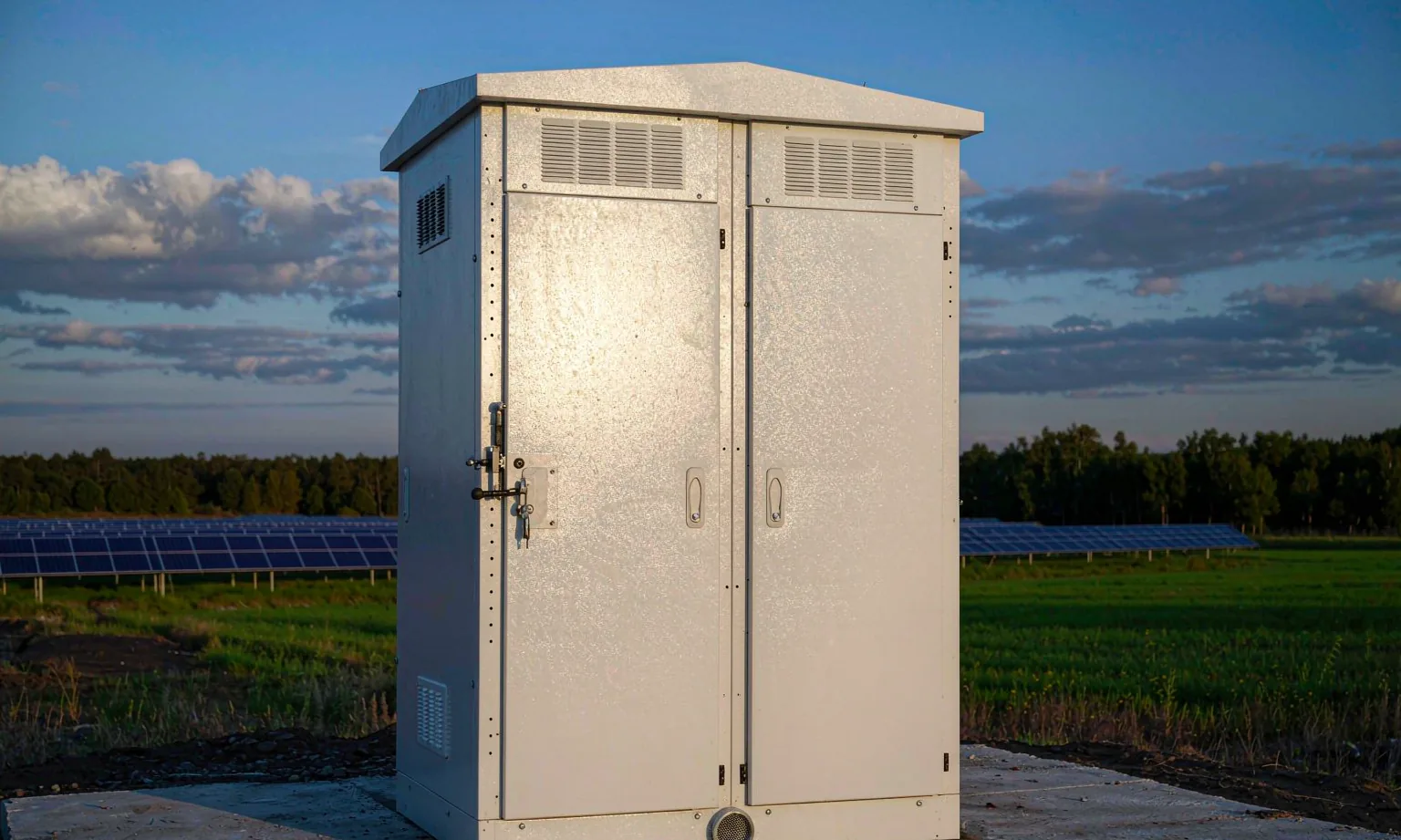
The Conflict at the Heart of Every BESS Enclosure
Heat and water do not negotiate. A cabinet that is fully sealed keeps everything out and also keeps everything in, including the heat that the modules and the power electronics generate. A cabinet that is generously ventilated moves heat efficiently and gives rain, dust and insects a route in.
The professional way to resolve this is not to pick one side and hope. It is to decide, in order: what the thermal load actually is, what environment the cabinet sits in, and then which of the three cooling architectures can satisfy both. The IP rating is the output of that decision, not an input to it.
That ordering matters because the cost difference between the options is large, and choosing the expensive one unnecessarily is as much a mistake as choosing the cheap one and failing in service.
What IP55 and IP66 Actually Require of Sheet Metal
The IP code has two digits. The first is solids, the second is water. Most cabinet arguments are about the second digit, but the first one is where dust ingress in industrial and desert sites is decided.
| Rating | Water exposure | What it demands of the build |
|---|---|---|
| IP54 | Splashing water from any direction | Gaskets on all joints, sealed cable entries, louvres with mesh |
| IP55 | Water jets from any direction | Continuous gasket compression, latch spacing that closes the perimeter, sealed gland plates |
| IP66 | Powerful water jets | Heavy gasket compression, welded or fully gasketed construction, no louvres, closed-loop cooling likely |
The sheet metal implications are consistent across all of them:
- Flat, continuous gasket surfaces. A frame that is spot welded close to the gasket line will pull and the gasket will not seal evenly.
- Controlled compression. The gap between door and frame must be set by the hinge and stop geometry so the gasket is compressed by design.
- Every entry sealed. Cable glands, breathers, drains and sight glasses are all penetrations.
- No unintended paths. A hole drilled for a fastener that passes into the interior is a leak even if a screw fills it.
Every Opening Is a Rating Risk
Openings are usually added late in a project, one at a time, and each one quietly erodes the rating. The useful discipline is to list them all on one drawing and design them together.
| Opening | Common mistake | Better practice |
|---|---|---|
| Louvre | Vertical slots straight through | Add a labyrinth or rain shield so water cannot travel straight in |
| Fan | Fan mounted over a plain cut-out | Use a shroud, and specify the filter change interval |
| Cable entry | Oversized gland plate with spare holes | Size the plate to the actual cables, or fit blanking plugs |
| Drain | Missing entirely | Fit a drain at the low point, protected from back-flow |
| Breather | Ignored | Use a membrane element where pressure changes are expected |
| Door | Single latch on a wide door | Multi-point latching to hold the whole perimeter closed |
Moving Heat Out: Three Architectures
| Architecture | Airflow | IP ceiling | Typical fit |
|---|---|---|---|
| Louvres plus internal circulation | Passive, low | Moderate spray | Small heat loads, sheltered sites |
| Filtered fan, forced convection | Active, high | Moderate | Indoor or sheltered with a maintenance regime |
| Closed loop with heat exchanger or cooling unit | Sealed interior | High | Outdoor, high heat load, dusty or coastal sites |
The choice is driven by the heat load in watts and the ambient temperature the cabinet must tolerate. Two numbers decide it: the total dissipation in the worst case, and the highest ambient the site will see. A cabinet designed for a mild climate and then installed in direct sun in a hot region can fail on a day the load is only half of nominal.
Where a closed-loop system is used, the sheet metal design still matters. The interior needs an air path that returns cooler air to the inlets of the equipment rather than short-circuiting across the cabinet, and the heat exchanger mounting face has to be flat enough to compress its own seal.
Condensation, Breathing and Pressure Equalisation
Condensation damages more cabinets than rain does, and it is invisible until something fails. Warm humid air enters, the cabinet cools overnight, and water appears on the inside of the shell.
Practical countermeasures, in order of cost:
- Seal the cabinet properly in the first place. The less air that moves in and out, the less moisture is carried in.
- Fit a pressure-compensation breather so air exchange happens through a membrane rather than through every gasket.
- Drain at the low point, with a protected drain that cannot admit water under wind-driven rain.
- Avoid large empty volumes and dead pockets where humid air can sit and cool.
- Consider a gentle internal air movement so the interior reaches a uniform temperature instead of forming a cold spot.
Note · A cabinet that is sealed but never pressure equalised will breathe anyway, just through the paths you did not choose. Giving it a defined breather is usually better than leaving the gaskets to do the job.
Gaskets, Sealing Surfaces and Door Hardware
Gasket selection is a combination of material, form and compression. The form factor that suits a small cover is often wrong for a large door, and the material that survives one climate may harden in another.
- Closed-cell sponge is the general-purpose choice for moderate conditions and repeated opening.
- Solid EPDM handles sun, ozone and temperature swings better but needs more compression force.
- Polyurethane foam compresses easily and suits irregular surfaces, at the cost of durability.
- Formed-in-place gaskets suit high volumes where the geometry is stable.
The sealing surface behind the gasket is the part that is most often wrong. If it is not flat, no gasket will fix it. Checking the flatness of the gasket line should be part of the first-article inspection, not a discovery at commissioning.
Verifying a Rating Instead of Assuming It
An IP rating is a claim about a tested or specified assembly. A fabricator can and should control the parameters the rating depends on, and can document them:
- Gasket line flatness checked on the first article and on a sample from each batch.
- Gasket compression confirmed against the drawing gap.
- Seam and weld continuity inspected where the enclosure is welded.
- Cable entry and drain details verified against the specification.
- Coating thickness and adhesion where the coating forms part of the environmental protection.
Where the contract requires a formal IP test, it should be carried out by an independent test house on a representative assembly, and the result kept with the order documents. That is a different activity from routine production inspection, and it should be planned as a separate line item rather than assumed.
Writing the IP and Thermal Requirement into the Brief
A short, clear environmental brief removes most of the risk in this area. It needs:
1. Installation location and exposure - indoor controlled, indoor industrial dusty, outdoor sheltered, outdoor exposed, coastal, wash-down. 2. Heat load in watts, worst case, with the equipment identified. 3. Maximum ambient temperature at the site, and whether the cabinet is in direct sun. 4. Required IP rating, with the cleaning and maintenance method the site will actually use. 5. Maintenance access - how often can a filter be changed, and by whom.
With those five answers, the cooling architecture and the enclosure design follow logically, and the quotation you receive will be for the right cabinet rather than a starting point for rework.
Our Approach to Sealed and Cooled Enclosures
- We build the enclosure to your IP requirement and document the details that carry it: gasket surfaces, latch positions, entry sealing and drain points.
- We will tell you when a specification is internally inconsistent - for example, a high IP target combined with an open louvre for a large heat load.
- We fabricate the mounting interfaces for heat exchangers and cooling units supplied by your chosen vendor.
- We do not select or supply the cooling equipment itself, and we do not certify the electrical design.
Send the heat load, the location and the required rating together with the drawings, and the enclosure design and the thermal approach can be resolved in one pass instead of three.
Frequently Asked Questions
Indoor cabinets in a clean, controlled room are commonly specified IP20 to IP54 depending on whether dust and accidental contact are a concern. Outdoor cabinets are typically specified IP54, IP55 or IP66. The rating should be tied to the installation location and to the cleaning method used on site, because a cabinet specified for a hose-down environment is a different design from one that only has to survive rain.
Not in the ordinary sense. A fan that pushes outside air through the cabinet is an open path, so the assembly will not achieve a high IP rating. The two ways to combine high protection with a real heat load are a closed-loop system - sealed interior with a heat exchanger or cooling unit - or moving the heat out through the metal itself with enough surface area and internal air circulation.
Sealed enclosures breathe. Temperature changes cause pressure differences that move air in and out past gaskets and cable entries, and moisture comes with it. When the cabinet cools, that moisture condenses on cold metal surfaces. Mitigations include a pressure-compensation element, a breather membrane, drain plugs at the low point, and avoiding large internal air pockets that hold humid air.
Louvres with insect mesh are a compromise. A well-designed louvre with a labyrinth path can still meet a moderate spray rating, but it will not meet a jet or immersion requirement. If the specification demands both high IP and airflow, the design normally moves to a filter-and-fan arrangement with a defined maintenance interval, or to closed-loop cooling.
Ask what was tested and how. A rating claim should be traceable either to a type test on a representative assembly or to a documented inspection regime that checks the parameters the rating depends on: gasket material and compression, surface flatness at the gasket line, continuity of welds and seams, cable entry sealing and louvre construction. Where a formal test is required by the project, it should be arranged with an independent test house and written into the order.
Explore Related Capabilities
- Energy Storage Cabinet Enclosures — BESS shells with sealed or closed-loop configurations
- Outdoor Battery Cabinets — Weatherproof battery and power cabinets
Have a Drawing to Quote?
Send STEP, DXF or PDF drawings and we reply with engineering feedback and a detailed quotation within 24 hours on working days.