Outdoor Battery Cabinet Fabrication: Weatherproofing, Venting and Long-Term Durability
Energy Storage Anjue Metal | Energy Storage | 12 min read | Updated Oct 12, 2026
An outdoor cabinet fails in the details, not in the concept. The shell is rarely the problem. Water arrives through a louvre that faces the prevailing wind, a gland plate that was drilled twice, a plinth that traps rainwater, or a gasket that was compressed at the latch and nowhere else. Weatherproofing is a set of small decisions made consistently.
- What "Outdoor" Actually Means
- Water Management: Roofs, Drips, Drains and Plinths
- Venting Without Letting Water In
- Materials and Coatings for C4 and C5 Environments
- Doors, Locks and Access in Bad Weather
- Installation Details That Decide Service Life
- A Specification Checklist
- Our Approach to Outdoor Enclosures
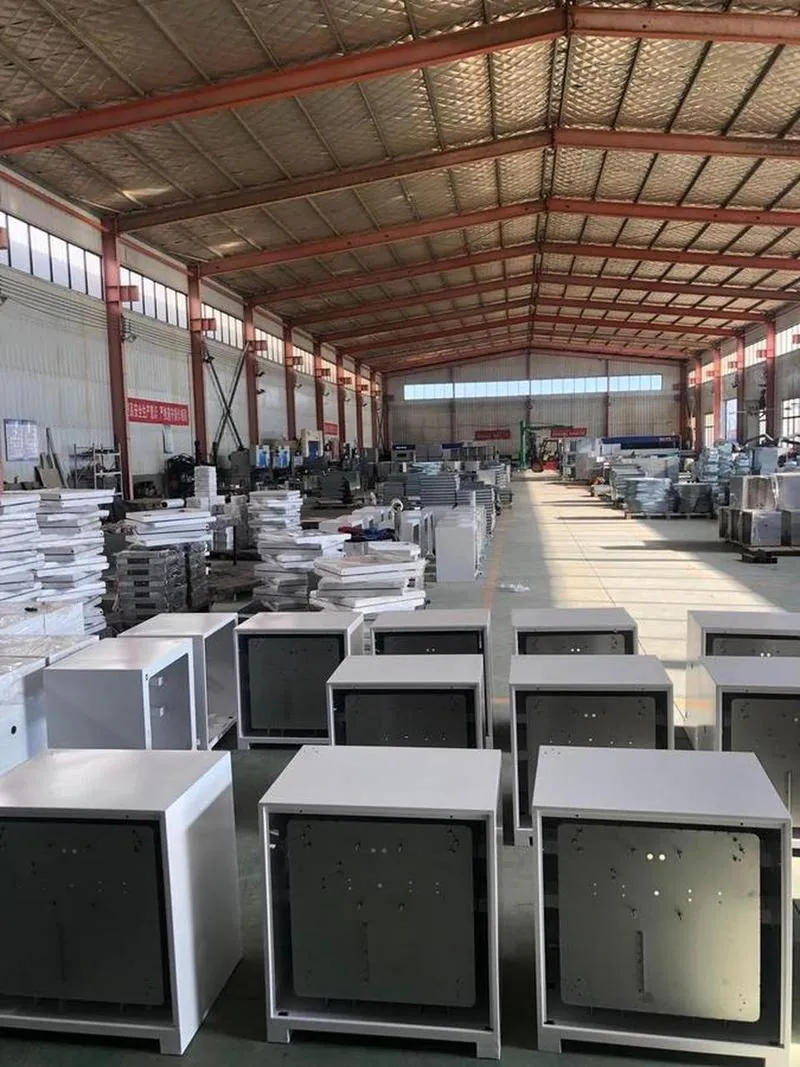
What "Outdoor" Actually Means
"Outdoor" is not one environment. It is at least five, and they call for different enclosures.
| Environment | Main threat | Design consequence |
|---|---|---|
| Sheltered yard under a canopy | Occasional wind-driven rain | Standard gaskets, modest louvre protection |
| Open site, temperate | Rain, sun, temperature cycling | Rain shields, UV-stable gaskets, drainage |
| Open site, hot and dusty | Dust ingress, thermal load | Filtered or closed-loop cooling, dust-tight entries |
| Coastal or marine | Salt spray, humid air | Corrosion category specification, stainless or heavy coating |
| Cold and snow | Snow load, freeze-thaw, condensation | Roof strength, drain protection, condensation control |
The specification should name the environment and the corrosion category. Without that, a fabricator can only guess, and the guess is usually too light for coastal sites and too heavy for a sheltered one.
Water Management: Roofs, Drips, Drains and Plinths
Water gets in by running, splashing, wicking and condensing. Each of those has a countermeasure, and they are all cheap if designed in.
- Running water. A sloped or crowned roof, a formed drip edge that throws water clear of the door line, and louvres that face away from the prevailing wind.
- Splashing water. Doors with a returned flange, sills at the bottom of openings, and a gasket line set back from the outer face so that water reaching the face has to travel uphill.
- Wicking water. A plinth or raised base that keeps the bottom edge of the shell out of standing water, and a base that drains rather than holds.
- Condensing water. A drain at the low point, and a breather or pressure-compensation element so the cabinet is not sealed only until the next temperature change.
The detail that most often gets missed is the plinth. Cabinets that sit flat on a concrete pad corrode at the bottom edge first, because the bottom of the shell stays wet for days after rain. A 50 to 100 mm raised base with a drainage gap, or a formed plinth with drain slots, is a small cost with an outsized effect on service life.
Venting Without Letting Water In
If the cabinet needs ventilation, the design of the opening decides whether it works.
- Use a formed blade profile, not plain drilled holes. A blade with a drip lip throws water off instead of passing it through.
- Back the opening with insect mesh. It keeps insects out and breaks up any water film that reaches the back of the louvre.
- Fit an external rain hood above the opening where the site is exposed, especially if the louvre cannot be turned away from the wind.
- Separate inlet and outlet so air crosses the equipment rather than short-circuiting between them.
- Filter where the environment is dusty and write the filter change interval into the maintenance plan, because a blocked filter stops the airflow and starts the overheating.
For any outdoor cabinet with a significant heat load, the honest option is usually closed-loop cooling: the interior stays sealed and a heat exchanger or cooling unit discharges the heat. It costs more than a louvre and it removes the largest single failure path.
Materials and Coatings for C4 and C5 Environments
| Substrate | Where it fits | Watch points |
|---|---|---|
| Cold-rolled steel with powder coating | Sheltered and temperate outdoor sites | Protect cut edges, specify pre-treatment |
| Hot-dip galvanised steel | Exposed sites, cut edges visible | Coating adhesion on zinc needs the right pre-treatment |
| Aluminium | Weight-sensitive and moderate corrosion | Isolate from steel to avoid galvanic corrosion |
| Stainless 304 | Industrial outdoor, moderate salt | Pitting in chloride-rich air |
| Stainless 316L | Coastal, marine, wash-down | Cost; still avoid standing deposits |
The practical rule is that the environment sets the corrosion category and the corrosion category sets the material and coating system, in that order. Reversing the order - choosing a material you already stock and then hoping it survives - is how cabinets end up with rust streaks at the bottom within two years.
Doors, Locks and Access in Bad Weather
A door on an outdoor cabinet has to do three jobs: seal, stay closed, and open easily when it is needed.
- Multi-point latching keeps the perimeter compressed, not just the hinge side.
- Adequate hinge load rating stops the door sagging after a few hundred openings; a sagging door leaks at the top corner.
- A door stop or stay prevents the door swinging into the wind and distorting the gasket line.
- Locks and handles sized for the environment, in a material that will not seize, and positioned so that a gloved hand can operate them.
- A door return flange and sill so water running down the face is directed away from the gasket.
Installation Details That Decide Service Life
Many "cabinet failures" are installation failures. Four items belong in the installation instructions:
1. Orientation. Doors and louvres should face away from the prevailing wind and away from direct afternoon sun where possible. 2. Clearance for airflow. A louvre pressed against a wall is not a vent. State the minimum clearance. 3. Drainage away from the footprint and a base that does not sit in a puddle. 4. Cable entries closed on site. Gland plates, blanking plugs and sealing compound are the site electrician's responsibility, and the drawing should say so.
A Specification Checklist
- Installation environment and corrosion category, stated.
- Required IP rating, tied to the cleaning method.
- Heat load in watts and maximum ambient, stated.
- Cooling approach: sealed, filtered vent, or closed loop.
- Roof form, drip edge and louvre orientation on the drawing.
- Raised base or plinth with drainage.
- Low-point drain and breather.
- Gasket material suited to UV and temperature range.
- Multi-point latching on wide doors.
- Coating system, pre-treatment and edge protection specified.
- Installation clearances and site sealing responsibilities written down.
Our Approach to Outdoor Enclosures
- We work from a stated environment and produce a design that matches it, rather than applying one generic "outdoor" build to every site.
- We fabricate the rain shields, drip edges, plinths and louvre profiles into the metal, so the protection is part of the part.
- We apply the coating over a specified pre-treatment, and we will say when a proposed coating system does not match the environment.
- We do not supply the cooling units, the electrical components or the site installation, and we do not certify the electrical design.
Send the site conditions, the heat load and the drawings, and the enclosure can be specified to survive the site rather than the catalogue.
Frequently Asked Questions
Most outdoor battery and power cabinets are specified IP54 or IP55, with IP66 reserved for exposed coastal or jet-wash environments. The rating should be matched to how the site will be cleaned and how exposed the cabinet is. A cabinet under a canopy in a sheltered yard and a cabinet on an open pole in a coastal region are different specifications even when they hold the same equipment.
Both options exist and the choice follows the heat load. A low heat load can be handled with a sealed shell and internal air movement, or with a small filtered vent. A high heat load in an outdoor cabinet normally requires closed-loop cooling with a heat exchanger, so that the interior stays sealed while the heat leaves. Ventilating the interior with outside air is the cheapest option and the easiest to get wrong, because it makes every louvre a potential water path.
By making the louvre path indirect and shielding the opening. A horizontal blade profile with a formed drip lip, backed by insect mesh, forces water to run off instead of passing through. Adding an external rain shield or hood above the opening, and orienting louvres away from the prevailing wind, removes most of the remaining risk. The aim is that no straight line exists from outside to inside.
It matters more than most buyers expect. A cabinet sitting directly on concrete wicks water into the base, holds moisture under the shell and corrodes at the bottom edge first. Raising the cabinet on a plinth or legs, providing drainage away from the footprint, and sealing the base penetrations properly are what turn a five-year cabinet into a fifteen-year one.
A powder coating system over the correct pre-treatment is the usual choice, with the pre-treatment specified for the substrate and the environment. Galvanised steel may be used where cut edges are exposed, and stainless is reserved for coastal or wash-down sites. The important point is that the specification should name the corrosion category the cabinet has to survive, so the coating system can be selected to match rather than guessed.
Explore Related Capabilities
- Outdoor Battery Cabinets — Weatherproof battery and power cabinet shells
- Powder Coating & Finishing — Coating systems for outdoor enclosures
Have a Drawing to Quote?
Send STEP, DXF or PDF drawings and we reply with engineering feedback and a detailed quotation within 24 hours on working days.