EV Charger Enclosure Fabrication: Wall Box, Pedestal and DC Fast Charger Bodies
EV Charging Anjue Metal | EV Charging | 12 min read | Updated Oct 12, 2026
An EV charger enclosure is a public-facing object that happens to contain electronics. It is designed against vandals, weather, accidental impact and the practical reality that a driver will yank the cable out of the holster. Those constraints shape the sheet metal more than the electrical content does.
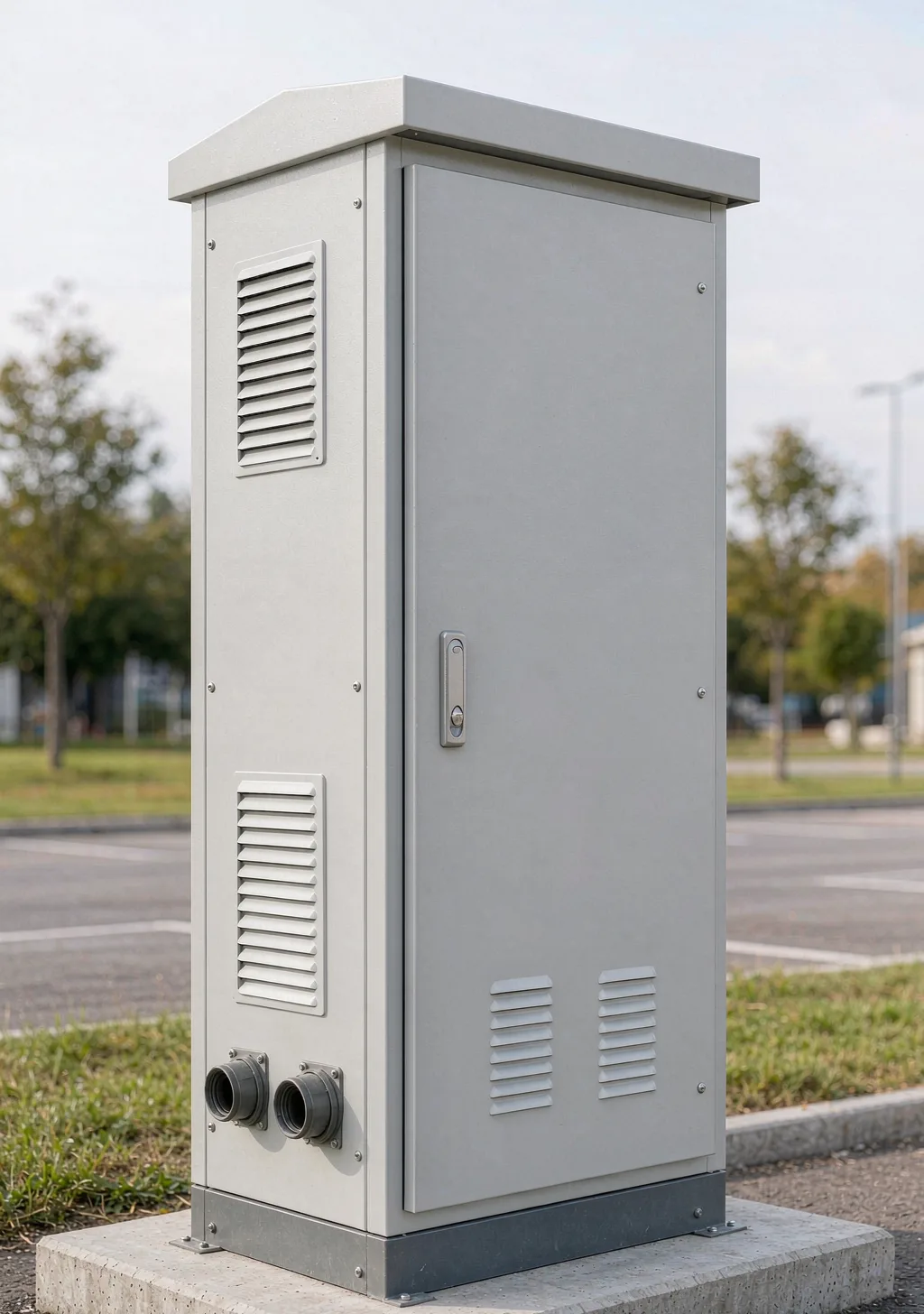
Three Formats, Three Different Enclosures
The phrase "EV charger enclosure" covers three products that share a purpose and very little else.
| Format | Typical construction | Main constraint |
|---|---|---|
| Wall box | Single shell, often aluminium, wall bracket | Weight, appearance, sealing at the cable entry |
| Pedestal or pillar | Post plus head unit, or a single formed body | Impact resistance, stability, cable management |
| DC fast charger cabinet | Large cabinet with one or two doors | Thermal load, service access, sealing at multiple entries |
The format decides the structural question before anything else. A wall box is carried and installed by hand, so weight matters. A pedestal is bolted down and struck by vehicles, so stiffness and anchoring matter. A DC cabinet is a small outdoor substation, so cooling and service access dominate.
Construction Details That Survive Real Use
Public chargers are treated badly. The design has to assume it.
- Front panels fixed properly. More fixings, a return flange or a concealed fixing, so the panel cannot be levered off with a screwdriver.
- Recessed fasteners where they are accessible to the public.
- Stiffened door edges. A door that flexes at the corner will not hold its gasket.
- Impact resistance in the panel, not just the frame. A stiff frame behind a soft panel does not stop a dent that traps the door.
- Cable holster designed as a wear part. It will be used thousands of times and should be replaceable without dismantling the cabinet.
Connector, Screen and Reader Interfaces
The user interface of a charger is a set of openings, and each one is a sheet metal feature with a tolerance.
- Screen windows need a flat mounting face, a defined window size and a bezel or gasket arrangement that keeps water out of the electronics compartment.
- Card readers and payment modules are usually supplied as a module with its own gasket; the enclosure provides a flat flange and a cut-out with a stated tolerance.
- Indicator lenses are small, easy to get wrong and visible to every user; a lens that sits proud of a curved panel is a detail worth resolving on the drawing.
- Emergency stop and isolation openings must be positioned for access and sized so that the device seals against the panel.
- Connector and cable entries are the largest penetrations and the ones most likely to leak if they are not designed as glands rather than holes.
Sealing Strategy, Feature by Feature
There is no single answer to sealing a charger, because a charger is not a sealed box - it has a cable, a screen and often a vent.
- Cable entry: a proper gland or grommet sized to the cable, mounted on a gland plate.
- Screen: a sealed bezel with a controlled compression, not adhesive foam alone.
- Vents: a louvre path that is never straight through, or a filtered fan with a stated change interval.
- Doors: multi-point latching so the perimeter closes evenly.
- Base or plinth: a raised base with drainage, so the bottom edge of the shell is not permanently wet.
Each of these is a separate decision, and the first-article inspection should confirm each one rather than only checking the overall dimensions.
Heat, Sun and the Colour of the Cabinet
Chargers are often installed in full sun, where the enclosure temperature can exceed ambient by a substantial margin before the electronics add anything.
- Light colours reduce solar gain and are the default for exposed installations.
- Shading and orientation belong in the installation instructions, since a cabinet in the shadow of a building runs materially cooler.
- Passive cooling through the shell suits wall boxes, where heat paths can be short and the enclosure is small.
- Forced or closed-loop cooling suits cabinets with a real dissipation figure.
- Do not stack electronics directly above the power stage unless the airflow path has been designed to carry the exhaust away from the control components.
Durability, Impact and Vandal Resistance
Impact and vandal resistance is a specification that has to be translated into metal, because a requirement that simply says "vandal resistant" gives a fabricator nothing to build.
- State the impact requirement the product must satisfy, and let the design follow.
- Increase panel thickness on the exposed faces, and keep internal frames stiff.
- Use returns and closed sections on panel edges, which add resistance without adding much weight.
- Protect the fixings, and use security fasteners where the panel is accessible.
- Design the connector holster to fail before the cabinet does, so a misuse incident damages a cheap part.
Briefing the Fabricator
1. Format and mounting method, with the mounting interface drawing. 2. Environment and required IP and impact ratings. 3. Dissipation at full load and maximum ambient, plus whether the unit is in full sun. 4. Component interface drawings - screen, reader, indicators, emergency stop, connector. 5. Cable entry sizes and quantities. 6. Volumes: prototype, pilot and production, and the expected design freeze point.
Our Approach to Charger Enclosures
- We fabricate wall box shells, pedestal bodies and cabinet structures, including the interface cut-outs for screens, readers and connectors.
- We cut the mounting and interface geometry into the flat pattern so modules land in the right place on the first article.
- We will say when a sealing or impact requirement cannot be met by the proposed construction, rather than discovering it at the first test.
- We do not supply the charging electronics, the connector assemblies or the cooling units, and we do not certify the electrical or safety design of the station.
- Every quotation states which operations are completed in our plant.
Send the format, the interface drawings and the environmental requirements, and the enclosure can be developed against the real installation case.
Frequently Asked Questions
Two materials dominate: coated steel for pedestal, pillar and cabinet bodies, and aluminium for smaller wall boxes where weight and appearance matter. Stainless appears in exposed or coastal installations and in premium products. The choice follows the same logic as any outdoor cabinet - the environment sets the corrosion requirement, and the mounting method sets the weight requirement.
A public charger is subject to impact from vehicles, trolleys and deliberate damage, and the specification usually states an impact resistance requirement. That translates into panel thickness, stiffening, the depth of returns on the edges, and how the front panel is fixed. A front panel held by four screws in thin sheet is easy to lever off, whatever the wall thickness.
By treating every feature separately and designing each one as a sealed penetration. The connector holster is a mechanical interface rather than an opening, but the cable entry into the cabinet is a real one and needs a proper gland or grommet. Screens need a sealed bezel. Vents, if used at all, need a louvre path that no water can travel straight through. In practice the sealing strategy is decided feature by feature and verified on the first article.
Wall boxes are usually passively cooled through the shell, which is one reason aluminium suits them. Pedestal and cabinet chargers have more dissipation and use forced air, closed-loop cooling or a combination. Because a charger often sits in direct sun, the shell colour and the amount of shading matter as much as the airflow path; a dark cabinet in full sun can run significantly hotter than the design case.
Yes, and it should, because alignment is a fabrication problem rather than an assembly problem when the cut-outs are made by laser. Screen windows, card reader apertures, indicator lenses and emergency stop openings are all cut and formed into the panel, with the tolerance held on the interface dimensions that the components require.
Explore Related Capabilities
- EV Charging Enclosures — Wall box, pedestal and charger cabinet bodies
- Waterproof Junction Boxes — IP-rated junction and terminal boxes
Have a Drawing to Quote?
Send STEP, DXF or PDF drawings and we reply with engineering feedback and a detailed quotation within 24 hours on working days.