EV Charger Enclosure Design: Structure, Separation and Safety Features
EV Charging Anjue Metal | Energy | 10 min read | Updated Oct 13, 2026
An EV charger is a piece of electrical equipment standing in a public place, often outdoors, often unattended, and always within reach of people and vehicles. The enclosure has to separate the live parts from the public, carry the electromechanical hardware that does the work, survive being hit and be maintainable by someone who did not build it. Most of that is decided in the sheet metal, and most of the common failures trace back to something the enclosure did not provide.
- What the Enclosure Is Responsible For
- Internal Separation and Clearance
- Earthing and Bonding
- Cable Management Inside and Outside
- Emergency Stop, Isolators and Operator Controls
- Impact, Vandalism and Door Stiffness
- Heat, Sun and the Charging Enclosure
- Labelling, Signage and Identification
- First-Article Checks
- How We Approach Charger Enclosures
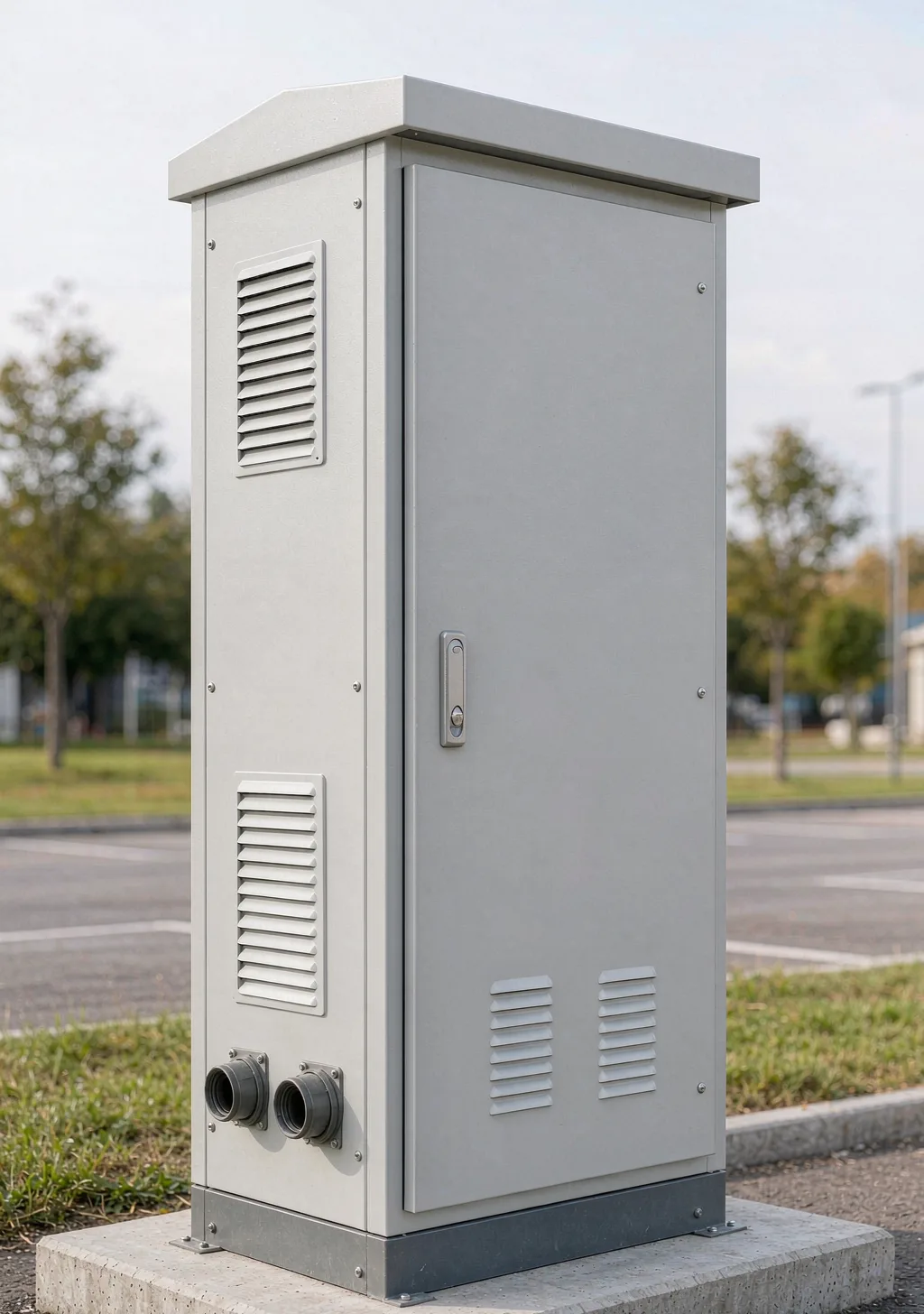
What the Enclosure Is Responsible For
| Requirement | The enclosure's part in it |
|---|---|
| Keep people from live parts | Barriers, doors, locks and clearances |
| Provide an earth path | Bonding points and continuous metalwork |
| Mount the electrical hardware | Rigid plates, rails and fixing patterns |
| Route the cables | Entries, ducts, supports and strain relief |
| Survive the weather | Sealing, drainage and material choice |
| Survive use and abuse | Impact resistance, fixings and door stiffness |
| Be serviceable | Access, labelling and isolation points |
Internal Separation and Clearance
- Provide internal barriers between the live power section and the parts a service person touches.
- Keep the clearances the electrical design requires, and design the mounting so that they cannot be reduced by a component substitution.
- Separate power and control wiring with a physical divider where the design calls for it.
- Give protective devices their own clearly marked space, sized so a replacement of the same type fits.
- Do not let a cable route pass over a component that may need to be removed.
- Provide shrouds or covers over terminals that would otherwise be accessible when a door is open.
Earthing and Bonding
- Provide a labelled main earthing terminal inside the enclosure, sized for the installation.
- Bond every door, cover and removable panel to the earth bar with a dedicated conductor, not through hinges alone.
- Keep bonding points accessible for testing, and record them on the drawing.
- Use bonding hardware suitable for the environment, especially at coastal or industrial sites.
- Ensure that a future paint repair does not break a bonding path; mask bonding faces before coating.
Cable Management Inside and Outside
- Provide entries sized for the cables plus spare, with removable gland plates.
- Give the charging cable a supported route and a proper strain relief.
- Provide a rest position or holster for a tethered cable, so it does not lie on the ground.
- Keep the cable bend radii within what the cable manufacturer specifies, which affects the space the enclosure must provide.
- Support internal harnesses so that they do not rest on hot or moving parts.
- Keep signal and power separated along their runs.
Emergency Stop, Isolators and Operator Controls
- Place controls where they can be reached without entering a traffic path and without opening the cabinet.
- Provide a rigid mounting plate or boss for each control, so the device seats flat and the button travels correctly.
- Route the wiring so that pressing a control does not strain the termination.
- Label isolation points clearly, both inside and outside where required.
- Keep indicators visible in daylight, and provide a shade or a recess where glare is a problem.
- Make the stop reachable by a person of short stature, which usually means placing it lower than a designer's instinct suggests.
Impact, Vandalism and Door Stiffness
- Design the door and its frame to stay closed and stay in shape under incidental contact.
- Use recessed locks and fixings so that a lever has nothing to catch.
- Stiffen exposed faces with returns and closed sections rather than with extra thickness everywhere.
- Provide replaceable wear parts, including trim, bezels and any sacrificial panel.
- Where vehicles are close, specify a separate protective structure rather than asking the enclosure to do a job it was not designed for.
Heat, Sun and the Charging Enclosure
- Remember that a DC charger has a significant internal heat load, and that a sun-exposed enclosure adds to it.
- Match the cooling method to the site: filtered air where it is clean, closed-loop exchange where it is not.
- Keep filters accessible and document their replacement interval.
- Use a light finish and shading where the cabinet faces the sun.
- Allow for condensation in a cabinet that cools overnight in a humid climate.
Labelling, Signage and Identification
- Provide mounting provisions for labels and signage that will not peel off or be removed by cleaning.
- Keep warning labels visible when doors are open and closed where the design requires both.
- Provide a unique identification position for the unit, so a service record can be tied to a physical charger.
- Mark cable entries and earth points for the installer.
- Keep legends readable after finishing; apply or engrave them after coating.
First-Article Checks
| Check | Method | Why it matters |
|---|---|---|
| Clearance to live parts | Gauge against the electrical drawing | Safety |
| Bonding continuity | Continuity check on doors and panels | Safety |
| Control mounting | Fit and function test | Operator safety |
| Cable entry and strain relief | Fit with a sample cable | Reliability |
| Door operation and locking | Open, close and lock test | Security and service |
| Impact-relevant stiffness | Visual and handling | Durability |
| Finish and labelling | Visual | Appearance and compliance with the customer's marking plan |
How We Approach Charger Enclosures
- We fabricate posts, bodies, doors, front panels, mounting plates, cable management parts, brackets and bases in steel, stainless and aluminium.
- We work to the component and device drawings you supply, and we keep the mounting faces flat and the clearances as drawn.
- We will tell you when a requested protection class, a requested cooling method and a requested internal layout cannot all be satisfied at once.
- We do not supply power modules, control electronics, cables, protective devices or payment systems, and we do not certify the electrical safety or the charging performance of the finished charger.
- Every quotation states which operations are completed in our plant.
Send the electrical layout, the device datasheets and the site conditions, and the enclosure can be built so that everything the electrical design assumes is actually there in the metal.
Frequently Asked Questions
It has to keep people away from live parts, provide a continuous earth path for every metal part that could become live, and give the internal components a rigid, correctly positioned mounting so that clearances are maintained. It also has to allow the cable entries and the internal separation the electrical design calls for. The enclosure does not make the charger safe on its own; it provides the physical conditions that the electrical design assumes.
By placing the enclosure where a vehicle is unlikely to reach, and by making the structure able to absorb an impact without exposing live parts or losing its position. Where the site puts the charger on a traffic line, a separate protective structure, such as bollards, is the normal answer, because no enclosure is designed to take a direct vehicle strike. What the enclosure can do is resist incidental contact, stay in place and keep its door closed.
The stop should be reachable without stepping into a traffic path and without opening the cabinet. That usually means a front-face position at a sensible height, mounted on a plate or a boss that gives it a rigid, correctly oriented seat, with the wiring routed so it is not strained when the button is pressed. The device itself is an electrical item supplied by others; the enclosure provides the mounting and the access.
With a routed, supported path from the cable management system to the outlet or the tethered cable, with a strain relief that takes the load off the termination, and with a rest position for a tethered cable that keeps it off the ground. Cable management is one of the parts of an EV charger that fails first, and the enclosure is what makes a proper cable path possible.
No. We fabricate the enclosure and its structural parts. We do not supply the power modules, the control electronics, the cable assemblies or the protective devices, and we do not test or certify the electrical safety, the interoperability or the charging performance of the finished product. We build to your drawing and state on every quotation which operations are completed in our plant.
Explore Related Capabilities
- EV Charging Station Enclosures — AC and DC charger housings and posts
- Outdoor Battery Cabinet Enclosures — Weatherproof cabinets for power equipment
Have a Drawing to Quote?
Send STEP, DXF or PDF drawings and we reply with engineering feedback and a detailed quotation within 24 hours on working days.