IP-Rated Enclosure Sealing: Glands, Gaskets and Cable Entries
Enclosures Anjue Metal | Industrial | 11 min read | Updated Oct 12, 2026
Almost every enclosure that fails its protection class fails for the same reason: not the door, not the gasket, but the cable entry. This guide covers the three elements that keep an ingress protection rating real in service, and the habits that quietly destroy it.
- A Rating Is an Assembly Property
- Gaskets: Types, Compression and Materials
- Cable Glands and Entry Sealing
- Breathers, Condensation and Pressure
- Doors, Hinges and Latch Effects
- Surface Finish and Sealing Faces
- Test Methods and What They Show
- Specifying Sealing Properly
- Checks That Keep a Rating Real
- Our Approach to Sealing
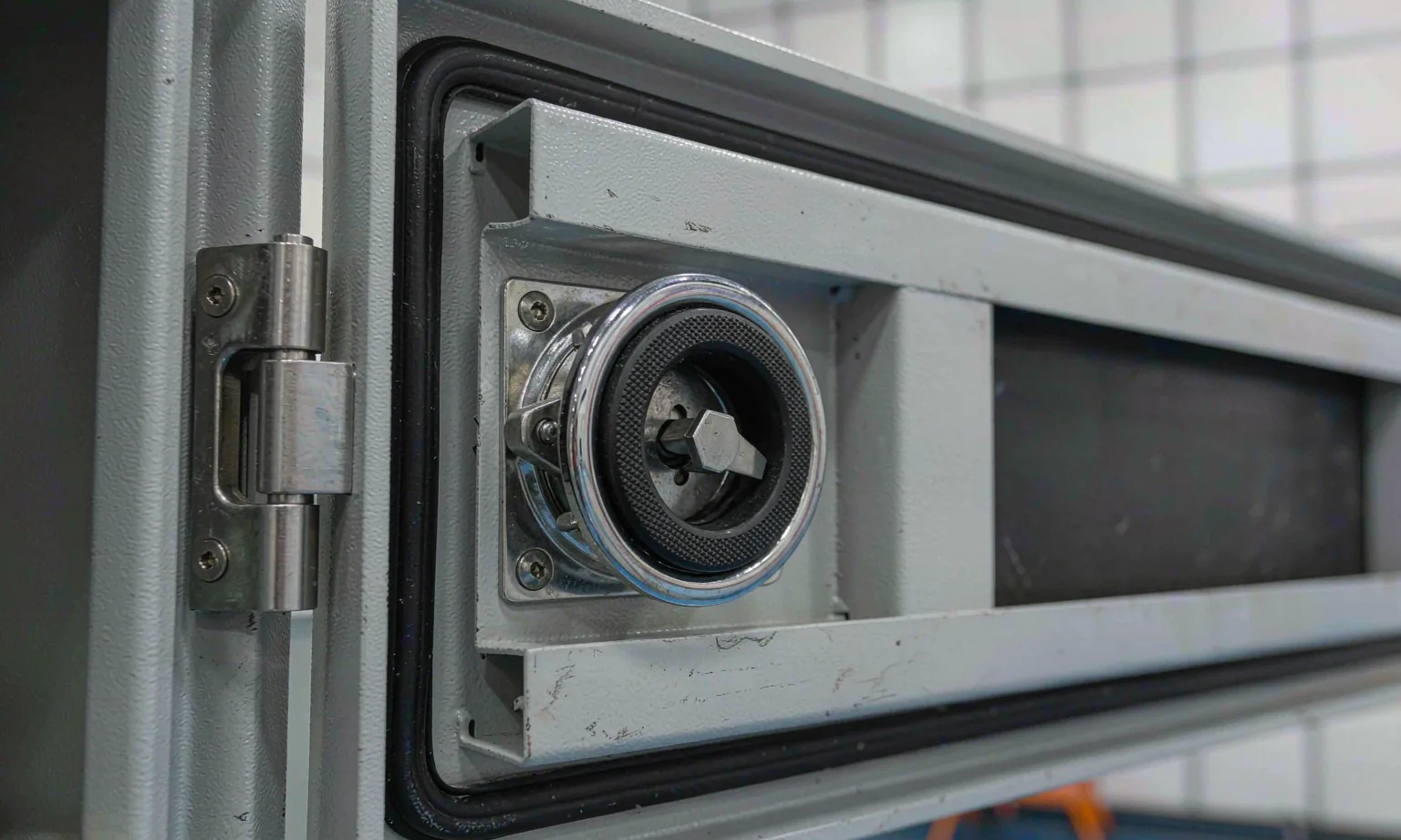
A Rating Is an Assembly Property
Ingress protection is demonstrated on a complete, installed assembly with its seals, its glands and its lid fixings. Every party in the chain can work to the drawing and the assembly can still fail.
| Element | Who controls it | Typical failure |
|---|---|---|
| Gasket | Enclosure supplier | Wrong material, or damaged in assembly |
| Sealing face | Fabricator | Distorted by welding or forming |
| Lid stiffness and fixings | Fabricator and assembler | Bows between fixings, or fixings left loose |
| Glands | Installer or supplier | Sized to nominal rather than measured cable |
| Entries | Fabricator and installer | Hand-drilled, or a plug omitted |
| Mounting | Installer | Water standing on the lid |
| Service | Maintainer | Gasket replaced incorrectly |
This is why the specification should name the parts in scope, not just the number.
Gaskets: Types, Compression and Materials
- Grooved gaskets stay in position during assembly and are the most reliable for a serviceable lid.
- Flange gaskets rely on adhesive or on the gasket being held by the fixing pattern.
- Foam gaskets seal at low compression and suit large covers with modest requirements.
- Solid rubber gaskets resist compression set better and suit higher ratings.
- Compression is set by the geometry of the lid, the groove and the fixings, not by how hard the lid is tightened.
- Material follows the temperature range, the UV exposure and, in food and chemical plants, the cleaning agents.
Cable Glands and Entry Sealing
- Size the gland to the measured cable diameter, not to a nominal size.
- Match the gland type to the cable: armoured, braided, plain or multi-core, each needs a different sealing arrangement.
- Use a gland plate where entries may change, and seal the plate to the enclosure as well as the gland to the plate.
- Where several cables share an entry, use a multi-cable insert rather than forcing cables through one gland.
- Provide strain relief so the cable weight is not carried by the gland or the terminal.
- Where the enclosure is outdoors, arrange the entry so that water cannot follow the cable in.
Breathers, Condensation and Pressure
- A pressure-equalisation element lets the enclosure breathe through a membrane that blocks liquid water and dust.
- A drain removes liquid water but compromises the rating, so it should be declared rather than hidden.
- A heater with a thermostat keeps the internal temperature above the dew point in cold conditions.
- Condensation damages more enclosures than rain does, particularly in a sealed box that cools overnight.
- Where a cooling unit is fitted, ensure its drain is routed outside the sealed volume.
Doors, Hinges and Latch Effects
- Keep the gasket line continuous; a hinge, a latch or a welded bracket that interrupts it is a path.
- Use multi-point latching on tall doors so the door does not bow away from the seal.
- Provide a door stop, so that opening the door fully does not distort the frame or the gasket.
- Where the door is removable, provide a location feature so that it returns to the same position.
- Check the gasket after service, because a door that has been closed on a trapped cable will not seal again.
Surface Finish and Sealing Faces
- Keep the sealing face flat along the seal path, which is usually a narrow band rather than the whole panel.
- Keep welds and their distortion away from the gasket line.
- Deburr and clean the sealing face, because a burr or a particle becomes a leak path.
- Where the face is coated, consider whether the gasket seals against the coating or against the substrate; a soft coating under compression can creep.
- Measure flatness on the seal path, not as an overall flatness of the panel.
Test Methods and What They Show
| Test | Covers | Note |
|---|---|---|
| Dust test | Solid particle ingress | First digit |
| Water jet | IPX5 and IPX6 | Different pressures, different results |
| Immersion | IPX7 and IPX8 | Different depths and durations |
| First-article inspection | The features the rating depends on | Replaceable in production |
| Production check | Gasket, lid, entries | By comparison with the first article |
A production enclosure is normally controlled by inspection against an agreed first article, and only tested formally when the standard or the customer requires it.
Specifying Sealing Properly
1. The rating and the test basis. 2. Which parts are in scope, including glands and plugs. 3. Sealing face flatness on the seal path. 4. Gasket material and the environment it will see. 5. Entry arrangement and who supplies the glands. 6. Whether a formal test is required, and by whom. 7. Whether a breather, a drain or a heater is part of the design.
Checks That Keep a Rating Real
- Verify the sealing face flatness on the seal path.
- Verify the gasket type, position and compression against the agreed sample.
- Check the entry positions and sizes against the schedule, and confirm the glands fit.
- Confirm that spare entries are plugged and sealed.
- Check the door or lid alignment and the fixing tightness.
- Confirm that mounting does not leave water standing on the lid.
- Keep a first-article record, so that production can be compared against an agreed baseline.
Our Approach to Sealing
- We keep the sealing faces flat, fit continuous gaskets and space the fixings so that the gasket is compressed evenly.
- We cut entries to the cable schedule and provide gland plates or plugged spares where the arrangement may change.
- We will say when a requested rating is incompatible with a requested door, entry or drain arrangement.
- We do not supply the glands, seals or breathers unless the order says so, and we do not certify the assembled enclosure's rating unless an independent test is commissioned.
- Every quotation states which operations are completed in our plant.
Send the rating, the entry schedule and the environment, and the enclosure can be built so that the number on the label is still true after the cables are in.
Frequently Asked Questions
The first digit describes protection against solid objects and dust, where 6 means dust tight. The second describes protection against water: 5 and 6 both involve a water jet, with 6 at higher pressure and flow, 7 covers temporary immersion, roughly to a metre for half an hour, and 8 is continuous immersion by agreement between the buyer and the supplier. A box rated IP66 is not automatically IP67, because jet and immersion are different tests.
Glands matched to the cable type, the cable diameter and the required rating, with the correct sealing insert and, where needed, an earth tag. The most common error is a gland sized to the nominal cable size rather than to the actual measured diameter, which leaves the seal loose. Where several cables share one entry, a multi-cable insert or a separate entry for each cable gives a more reliable result than a single large gland.
Often yes, for a different reason than water ingress. A sealed enclosure that heats and cools will draw air in and out through the seals as the internal pressure changes, and that air carries moisture. A pressure-equalisation element lets the enclosure breathe through a membrane that blocks liquid water and dust, which reduces condensation and reduces the load on the gasket. It is a deliberate design choice, not a leak.
A sealing face that is not flat. Welding near the gasket line, a forming operation that leaves the flange bowed, or a large lid with too few fixings will all produce a face the gasket cannot follow. The gasket is rarely the problem; the surface it seals against usually is.
As the rating, the test basis and the responsibility split. State which parts of the assembly are in scope, whether the glands and cable entries are included, whether a formal test is required and who supplies the seals. An enclosure specified as a rating alone leaves the assembler to discover the entry problem after installation, which is the worst possible time.
Explore Related Capabilities
- Waterproof Junction Boxes — IP-rated boxes built around a rating
- Electrical Enclosures & Cabinets — Outdoor and wash-down rated cabinets
Have a Drawing to Quote?
Send STEP, DXF or PDF drawings and we reply with engineering feedback and a detailed quotation within 24 hours on working days.