Sheet Metal Parts in Liquid Cooling Systems: CDU Housings, Manifolds and Trays
Liquid Cooling Anjue Metal | Liquid Cooling | 11 min read | Updated Oct 12, 2026
Liquid cooling has become a data centre topic, and the sheet metal around it is often specified late. Some of the hardware is machined or brazed and some of it is fabricated, and a brief that does not separate the two produces suppliers who cannot quote and buyers who cannot compare. This guide sets out which parts are sheet metal, and how they are made well.
- What Is Sheet Metal and What Is Not
- CDU Enclosures and Their Internals
- Manifold Brackets, Clamps and Routing
- Drip Trays, Containment and Leak Detection
- Material Choice and Galvanic Compatibility
- Joining Methods for Liquid Systems
- Leak Tightness and What the Test Proves
- Finish and Cleanliness
- First-Article and Production Checks
- Our Approach to Liquid-Cooling Sheet Metal
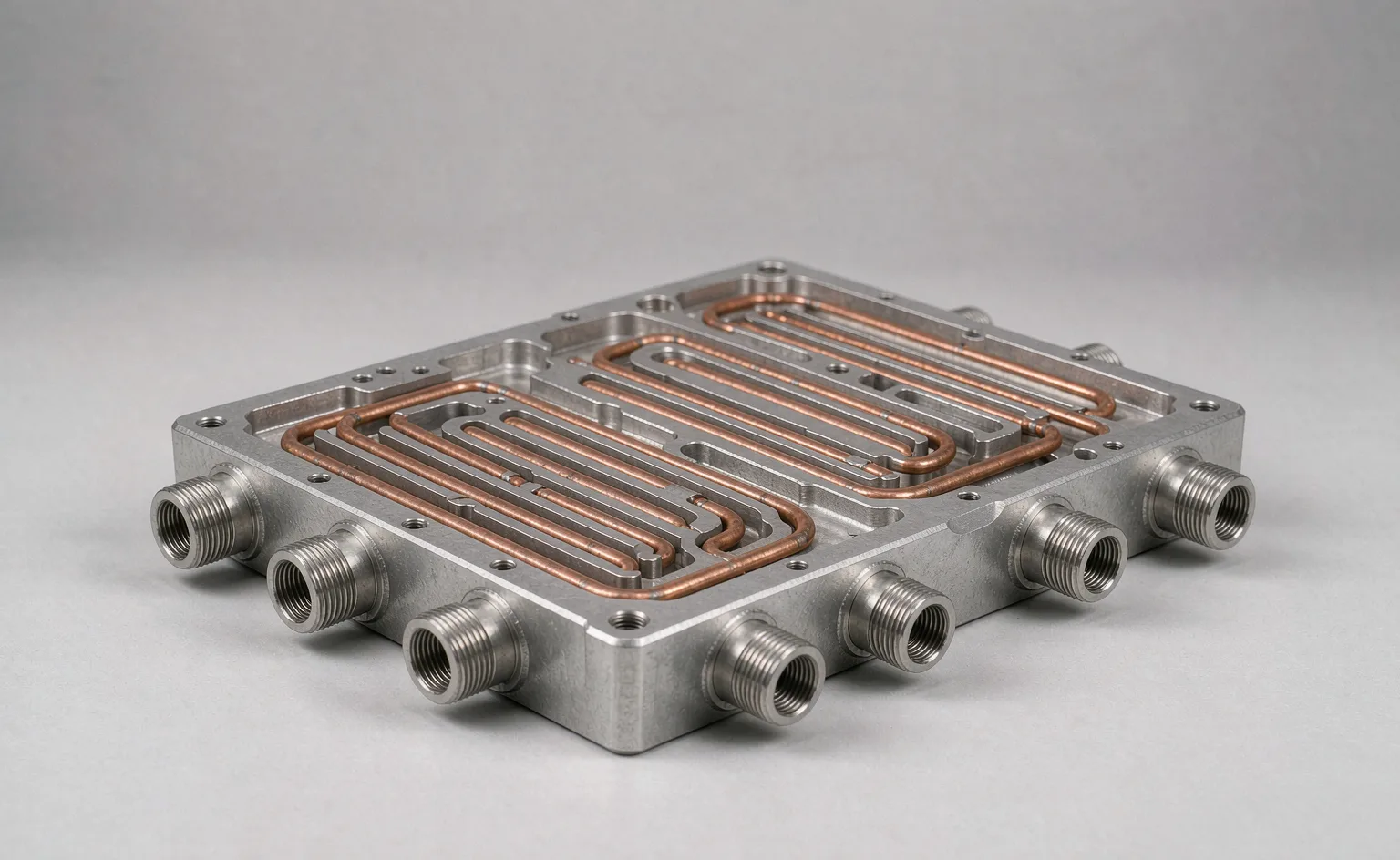
What Is Sheet Metal and What Is Not
| Component | Typical process | Sheet metal role |
|---|---|---|
| Cold plate | Machined, skived or brazed | Bracket and support |
| Manifold body | Machined or tube and fitting | Bracket, clamp, routing |
| Hose and pipe | Purchased | Routing brackets and supports |
| CDU enclosure | Fabricated | The whole enclosure |
| Drip tray | Fabricated | The whole part |
| Rack manifold support | Fabricated | The whole part |
| Leak detection cover | Fabricated | The whole part |
Being explicit about this split at the enquiry stage means each part goes to a supplier who can actually make it, and the interfaces between them are defined rather than assumed.
CDU Enclosures and Their Internals
A coolant distribution unit is an enclosure with wet and dry zones sharing one cabinet.
- Separate the wet zone with a floor or a liner so that a leak is contained rather than spread.
- Drip trays under pumps, heat exchangers and fittings, with a drain or a leak sensor pocket.
- Mounting plates stiff enough for a pump, dimensioned so that the pump's mounting pattern is a datum rather than a slot.
- Service access sized for the largest component, because a heat exchanger cannot be removed through a side panel.
- Airflow and blanking panels where the CDU sits in a rack and has to respect the rack's thermal design.
- Hose routing brackets that hold the bend radius and keep flexible hose away from sharp edges.
Manifold Brackets, Clamps and Routing
The manifold is usually supplied as a finished assembly; the sheet metal holds it in the right place.
- Provide a repeatable mounting datum so that every manifold lands at the same height and position.
- Use clamps with a defined rubber or polymer interface so the manifold is not scratched or galvanically coupled.
- Include adjustment where the manifold has to align with a cold plate or a rack position.
- Design brackets for the hose loads, because a filled hose is heavy and a bracket that only carries the manifold will sag.
- Keep flexible hose away from sharp edges and from hot surfaces.
Drip Trays, Containment and Leak Detection
A drip tray is a simple part that is frequently made badly.
- Form a proper sump, so a small leak collects at one point rather than spreading over a flat base.
- Provide a drain and a sensor pocket, positioned where the fluid will actually collect.
- Turn up the edges high enough for the volume being protected, and weld the corners rather than relying on a sealant.
- Direct any overflow away from electrical components and cabling.
- Allow the tray to be removed or cleaned, because a contaminated tray is a maintenance problem.
Material Choice and Galvanic Compatibility
- Aluminium is common for weight and for compatibility with aluminium cold plates and manifolds.
- Stainless 304 or 316L suits parts that see condensate, cleaning chemicals or a corrosive environment.
- Coated steel is acceptable for dry enclosures and for parts that never touch coolant.
- Galvanic pairs matter: an aluminium part fastened with stainless fixings in a wet environment needs isolation, and a copper fitting in an aluminium tray is a corrosion cell.
- Condensate is the hidden exposure, because a cold surface in humid air is wet even if no coolant ever escapes.
Joining Methods for Liquid Systems
| Method | Use | Note |
|---|---|---|
| TIG welding | Sealing trays and enclosures | Full penetration where the joint must be fluid tight |
| Spot welding | Structural, dry joints | Not fluid tight |
| Riveting | Dry assemblies | Requires a sealed interface if wet |
| Brazing | Tube and fitting assemblies | Often a specialist process |
| Adhesive or sealant | Secondary sealing | Not a primary sealing method |
Where a joint has to be fluid tight, the specification should say so and the inspection should verify it, because a joint that is sealed only by a gasket can be reassembled wrongly.
Leak Tightness and What the Test Proves
- State the leak rate, not just the word "leak tested".
- Pressure decay is a practical production test for a defined volume at a defined pressure.
- Helium testing is used where the allowable leak rate is very small.
- Water or bubble testing is a quick screen and is often adequate for trays and containment features.
- Test the assembly as it will be used, because a fitting torqued differently on the test bench may behave differently in service.
Finish and Cleanliness
- Mask sealing faces and threaded interfaces so that they stay clean and dimensionally correct.
- Avoid loose coatings inside a wet zone, because a flaking coating becomes contamination.
- Deburr and clean all internal surfaces, and remove swarf and cutting fluid before packing.
- Cap or plug open ports before shipping, so the part arrives clean and closed.
- State the cleanliness requirement in the purchase specification, including the maximum particle size and whether the part must be dry.
First-Article and Production Checks
| Check | Method | Why |
|---|---|---|
| Manifold or pump mounting datum | Gauge against the interface drawing | Assembly alignment |
| Drip tray welds | Visual and water test | Containment |
| Flatness of sealing faces | Straight edge or gauge | Gasket performance |
| Deburring and cleanliness | Visual and wipe test | Pump and channel protection |
| Bracket stiffness | Load check where specified | Hose and manifold loads |
| Port protection | Visual | Cleanliness on arrival |
Our Approach to Liquid-Cooling Sheet Metal
- We fabricate CDU chassis and enclosures, mounting plates, manifold brackets and clamps, drip trays, hose routing brackets and airflow panels.
- We weld and seal the parts that have to contain fluid, and we test them against a stated leak rate where the specification requires it.
- We will tell you when a requested cleanliness or flatness requirement cannot be met by the proposed construction and finish.
- We do not machine or braze cold plates or manifold bodies, and we do not supply pumps, heat exchangers, hoses or coolant.
- Every quotation states which operations are completed in our plant.
Send the wet-zone layout, the interface drawings and the leak rate you need, and the sheet metal scope can be separated cleanly from the parts that belong to another supplier.
Frequently Asked Questions
Not usually. A cold plate is normally a machined or skived component, often brazed to a cover or bonded into an assembly, because the internal channel geometry and the flatness requirement are beyond what sheet metal forming delivers. What sheet metal contributes around a cold plate is the support bracket, the manifold, the drip tray and the enclosure. Separating these clearly at the enquiry stage saves a great deal of time.
A coolant distribution unit is usually a rack-mounted or floor-standing sheet metal enclosure containing pumps, heat exchangers, sensors and controls. The sheet metal scope is the chassis or cabinet, the panels and doors, the mounting plates for the pumps and the heat exchanger, the drip tray under the wet components, the cable and hose routing brackets, and often the blanking and airflow panels.
The usual methods are a pressure decay or hydrostatic test on the assembly, a helium leak test where very small leak rates must be detected, and a water or bubble test as a low-cost screen. Which one is appropriate depends on the leak rate the specification requires, and it is important to state that rate rather than simply asking for a leak test. Where the sheet metal part is a tray or an enclosure rather than a pressurised body, the test is often a water test on the containment feature instead.
Where the part touches coolant, the material has to be compatible with the fluid and with the other metals in the loop, because mixed metals in a conductive fluid create galvanic corrosion. Aluminium and stainless are common, copper and brass appear in fittings, and the combination has to be considered as a system. Where the sheet metal only forms the enclosure around the wet components, the constraint is corrosion resistance from condensation rather than fluid compatibility.
By stating the maximum particle size and the maximum residual contamination the circuit allows, as well as whether the part is supplied dry. A machined or fabricated part that reaches the customer with swarf, cutting fluid or loose paint inside it can damage a pump or block a microchannel. Cleanliness requirements should therefore be written into the purchase specification and verified, not assumed.
Explore Related Capabilities
- Liquid Cooling Parts — Cold plate supports, manifolds and CDU housings
- CNC Machining — Machined components and interfaces
Have a Drawing to Quote?
Send STEP, DXF or PDF drawings and we reply with engineering feedback and a detailed quotation within 24 hours on working days.